
Self-Taught Developer Readiness Calculator
Skill & Experience Checklist
Check off the milestones you have achieved.
Readiness Score
You see the headlines. "I quit my job and learned to code in three months." "Self-taught developer hired by Google." It sounds like a movie script, doesn't it? The reality is messier, but the answer to whether you can become a self-taught coder is a resounding yes. Thousands of developers today started exactly where you are: with no degree, no formal mentorship, and just a laptop.
But here is the catch. Being able to write code and being employable as a professional developer are two very different things. The gap between "I made a calculator app" and "I can maintain a complex production system" is vast. This guide breaks down how to bridge that gap without spending tens of thousands on a bootcamp or university tuition.
The Myth of the Natural Programmer
There is a persistent myth in tech that you need a Computer Science (CS) degree to understand how computers work. This is simply not true. While CS degrees teach valuable theory-like data structures, algorithms, and computer architecture-they often lag behind industry trends. A university curriculum might still emphasize Java when the market is hungry for JavaScript or Python developers.
Self-taught developers are individuals who acquire programming skills through independent study, online resources, and practical application rather than formal academic instruction. They tend to be more agile in adopting new technologies because they are used to hunting for information. However, they often lack the foundational theoretical knowledge that helps senior engineers solve complex architectural problems.
The key difference isn't intelligence; it's discipline. Formal education provides structure. When you teach yourself, you have to build that structure from scratch. If you don't, you risk falling into "tutorial hell," where you watch endless videos but never actually build anything on your own.
Building Your Roadmap: Where to Start
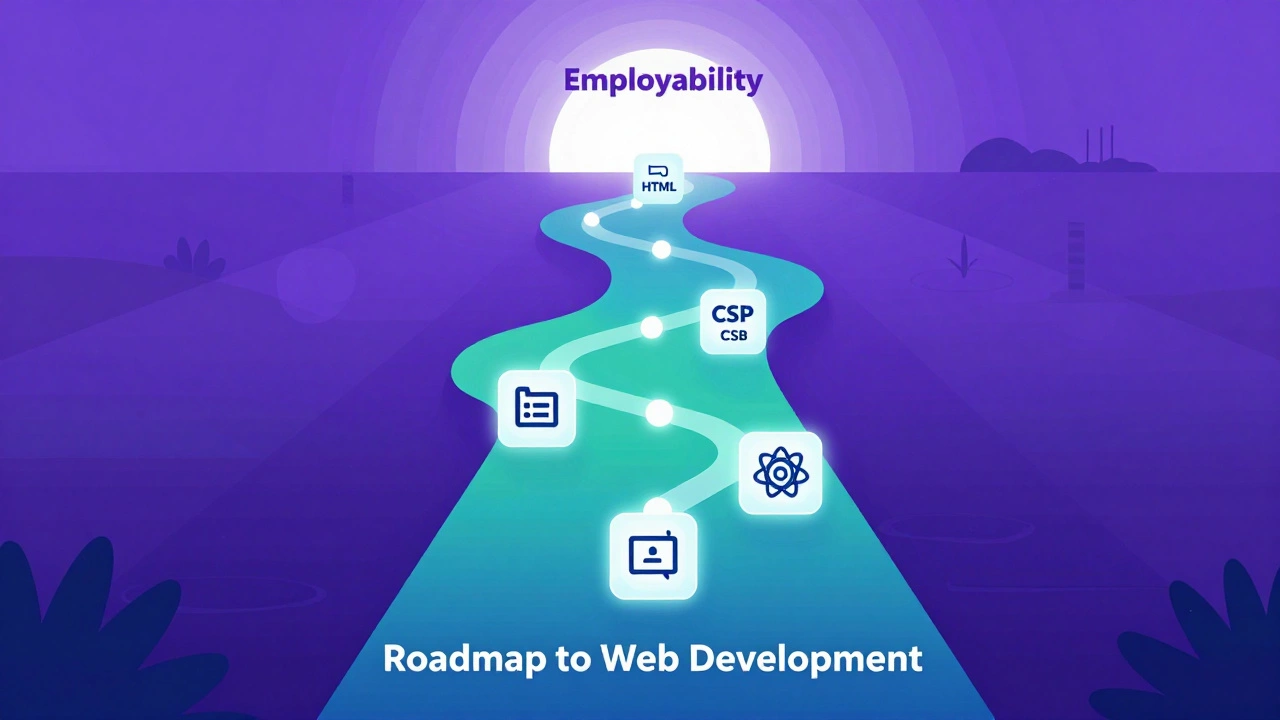
Without a syllabus, it is easy to get overwhelmed. There are too many languages, frameworks, and tools. Here is a simplified path for most beginners aiming for web development, which has the lowest barrier to entry:
- HTML & CSS: These are not programming languages, but markup and styling languages. You cannot build a website without them. Learn how to structure content and make it look decent.
- JavaScript: This is the engine of the web. It makes pages interactive. Master the basics: variables, functions, loops, and DOM manipulation.
- Git & GitHub: Version control is non-negotiable. You need to know how to save changes, revert mistakes, and collaborate with others. GitHub is where your portfolio lives.
- A Frontend Framework: Once you know vanilla JavaScript, learn React, Vue, or Angular. React is currently the most popular and has the largest job market.
- Backend Basics: Learn Node.js or Python. Understand how servers work, what APIs are, and how databases store data.
Don't try to learn everything at once. Pick one stack and stick to it until you can build a complete project. Depth beats breadth when you are starting out.
Resources That Actually Work
The internet is flooded with free content, but quality varies wildly. Here are reliable resources that have stood the test of time:
- freeCodeCamp: A nonprofit with a structured curriculum. It’s great for beginners because it forces you to write code to pass lessons.
- The Odin Project: Often cited as the best full-stack curriculum. It is opinionated, meaning it tells you exactly what to install and how to set up your environment, which saves hours of frustration.
- MDN Web Docs: The bible for web developers. When you forget how a specific CSS property works, this is where you go. It is maintained by Mozilla and is incredibly accurate.
- YouTube Channels: Traversy Media, Fireship, and Web Dev Simplify offer concise, high-quality tutorials on specific topics.
Avoid paid courses unless they offer a unique structure or mentorship. Most $50 Udemy courses are outdated within six months. Free resources are updated constantly by the community.
The Portfolio Problem: Proving You Can Code
This is where most self-taught coders fail. They spend six months watching tutorials and end up with zero projects to show employers. Your portfolio is your resume. It needs to demonstrate that you can solve real problems.
Do not build another To-Do list app or weather widget. Every junior developer has one. Instead, build projects that solve a problem you care about:
- Automate a boring task: Write a script that organizes your downloads folder or scrapes prices from e-commerce sites.
- Clone a service: Build a simplified version of Twitter or Netflix. Focus on the core features: user authentication, data fetching, and dynamic UI updates.
- Contribute to Open Source: Find a small library on GitHub and fix a bug or improve documentation. This shows you can read other people's code-a critical skill for any job.
When hiring managers look at your GitHub, they want to see clean code, commit history that shows consistent effort, and README files that explain how to run your project. If your code is messy and unexplained, they will assume you cannot communicate technical ideas clearly.
Coding Classes vs. Self-Study: The Trade-Offs
Should you pay for coding classes? It depends on your learning style and budget. Let’s compare the two approaches honestly.
| Factor | Self-Taught | Coding Classes / Bootcamps |
|---|---|---|
| Cost | $0 - $100 (optional books/courses) | $5,000 - $20,000+ |
| Time Commitment | Flexible, but requires extreme discipline | Fixed schedule, immersive (3-6 months) |
| Mentorship | Community forums, Discord, Stack Overflow | Dedicated instructors, peer support |
| Networking | You must build it yourself | Built-in alumni network, career services |
| Curriculum | You design it (risk of gaps) | Industry-aligned, structured |
Coding classes provide accountability. If you struggle with motivation, paying for a bootcamp might force you to focus. They also offer career coaching, which is invaluable if you don’t know how to navigate the job market. However, many bootcamps have low job placement rates, and the debt can be significant. Self-study requires you to be your own project manager. If you are disciplined, it is far more cost-effective.

Overcoming Imposter Syndrome
No matter how much you learn, you will feel like a fraud. This is called imposter syndrome, and it affects even senior engineers with PhDs. In tech, technology changes so fast that everyone is constantly learning. Feeling lost is normal.
To combat this, focus on progress, not perfection. Celebrate small wins: fixing a bug, understanding a complex concept, or getting a pull request merged. Join communities like Reddit’s r/learnprogramming or local meetups. Talking to other developers reminds you that everyone struggles, especially at the beginning.
Getting Hired Without a Degree
Employers care about two things: can you do the job, and will you fit into the team? Your portfolio proves the first. Your communication skills prove the second.
Start applying early. Do not wait until you feel "ready." You will never feel ready. Apply to junior roles, internships, and contract positions. Tailor your resume to highlight projects and skills, not education. Use keywords from the job description. If a job asks for React experience, make sure your portfolio features a React project prominently.
Network aggressively. Reach out to developers on LinkedIn. Ask for advice, not jobs. People love to help those who are genuinely curious. Many jobs are filled through referrals before they are ever posted publicly.
Be prepared for technical interviews. Practice coding challenges on platforms like LeetCode or HackerRank. Focus on basic data structures and algorithms. Even if you are applying for frontend roles, companies often test logical thinking through these problems.
Is Self-Taught Enough for Long-Term Growth?
Yes, but you may hit a ceiling eventually. As you move into senior roles, theoretical knowledge becomes more important. Understanding memory management, concurrency, and system design helps you build scalable applications. If you find yourself stuck, consider taking specific university courses online (via Coursera or edX) to fill those gaps. You don’t need a full degree, just targeted knowledge.
The tech industry values results over credentials. If you can ship code that users love, no one cares how you learned to do it. Stay curious, keep building, and never stop learning.
How long does it take to become a self-taught coder?
It typically takes 6 to 12 months of dedicated study (15-20 hours per week) to become job-ready for an entry-level position. However, mastery is a lifelong journey. Some people land jobs in 3 months, while others take 2 years. Consistency matters more than speed.
Which programming language should I learn first?
For web development, start with HTML, CSS, and JavaScript. For data science or automation, Python is an excellent choice. JavaScript is the most versatile because it runs in browsers and on servers (Node.js), allowing you to build full-stack applications.
Can I get a job as a programmer without a degree?
Yes, absolutely. Many tech companies, including Google, Apple, and IBM, have dropped degree requirements for certain roles. They prioritize skills, portfolios, and cultural fit. However, some large enterprises or government jobs may still require a degree, so research your target companies.
What are the biggest mistakes self-taught developers make?
The biggest mistake is staying in tutorial hell-watching videos without building original projects. Other common errors include ignoring fundamentals (like Git and debugging), trying to learn too many languages at once, and neglecting soft skills like communication and teamwork.
Are coding bootcamps worth the money?
Bootcamps can be worth it if you need structure, mentorship, and career support, and if you can afford the cost. However, they are not a guarantee of employment. Research the bootcamp’s job placement rate and talk to alumni before enrolling. Self-study is cheaper but requires more self-discipline.
How do I stand out to employers as a self-taught candidate?
Build a strong portfolio with unique, well-documented projects. Contribute to open-source software. Network actively on LinkedIn and at tech meetups. Demonstrate problem-solving skills during interviews by explaining your thought process, not just your code.