
Degree Suitability Calculator for Exam Aspirants
Configure Your Profile
Strategic Insight
Ready to Analyze
Enter your details to see which degree offers the best strategic advantage.
There is a dangerous myth floating around college campuses and online forums: the idea of an "easy" degree. You’ve probably seen the memes or read the Reddit threads claiming that one major lets you coast through four years with minimal effort. But if you are asking this question because you are preparing for competitive exams like civil services, banking, or public sector entrance tests, your definition of "easy" needs a serious reality check.
For someone focused on clearing high-stakes government or corporate entrance exams, the "easiest" degree isn't necessarily the one with the lowest GPA requirement. It is the one that demands the least amount of time away from your primary goal: studying for the exam. The best degree acts as a safety net-a qualification that gets you eligible for the job without consuming your mental energy.
The Strategic Approach: Eligibility Over Excellence
Let’s be clear about what you are trying to achieve. In most countries, including India and many Commonwealth nations, thousands of government positions require only a bachelor's degree in any discipline. They do not care if you are a genius in Quantum Physics or a novice in Philosophy. They care that you hold the certificate.
Therefore, the easiest degree is defined by three metrics:
- Time Commitment: How many hours per week does it demand outside of class?
- Cognitive Load: Does the subject matter overlap with your exam syllabus?
- Pass Rate: Is the grading curve forgiving?
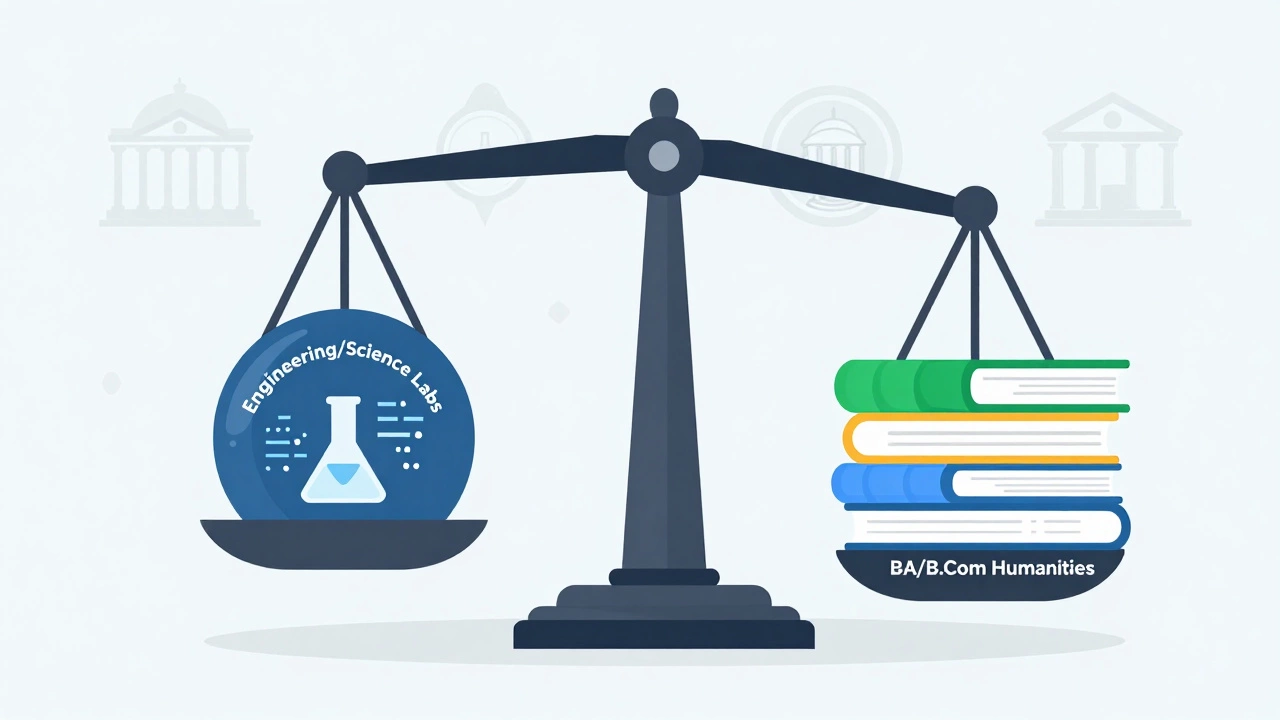
If you choose a degree that requires complex labs, intense coding projects, or clinical rotations, you are setting yourself up for failure in your competitive exam prep. You need a degree that allows you to treat university as a part-time obligation while keeping your full-time focus on the exam.
Top Contenders for the "Easiest" Degree
Based on curriculum structure and workload, here are the degrees that typically offer the most flexibility for serious exam aspirants.
1. Bachelor of Arts (BA) in Humanities
A BA in subjects like History, Political Science, Sociology, or Psychology is often cited as the most manageable path. Why? Because these subjects rely heavily on reading and writing rather than memorizing formulas or conducting experiments. If you are preparing for exams like the UPSC Civil Services Examination (CSE), there is a massive overlap between your degree coursework and the General Studies papers. You can write an essay for your Political Science class that also serves as practice for your Mains exam. This double-duty approach saves hundreds of hours.
2. Bachelor of Commerce (B.Com)
For those leaning toward banking exams (like IBPS PO or SBI Clerk) or accounting roles, a B.Com is efficient. The syllabus is structured and predictable. Unlike engineering, where concepts build on each other in complex ways, commerce topics are often modular. You can study Accounting one week and Business Laws the next without needing to understand the deep theoretical underpinnings of both simultaneously. It is straightforward, rule-based, and generally has a higher pass rate than science streams.
3. Bachelor of Education (B.Ed) or Post-Graduate Diplomas
If you already have a graduate degree, pursuing a B.Ed or a similar professional diploma is often less rigorous than a full second bachelor's. These programs are designed for working professionals or teachers. The assessments are usually practical-lesson plans, teaching demonstrations, and reflective journals-rather than high-pressure theoretical exams. This makes it an excellent option if you are targeting teaching recruitment boards or educational administration roles.
| Degree Type | Weekly Study Load (Est.) | Exam Syllabus Overlap | Flexibility for Self-Study |
|---|---|---|---|
| BA (Humanities) | Low-Medium | High (for Civil Services) | Very High |
| B.Com | Medium | Medium (for Banking/Finance) | High |
| B.Sc (General) | High | Low (unless specific science posts) | Low |
| B.Tech / Engineering | Very High | Very Low | Very Low |
| LLB (Law) | High | Medium (for Legal Services) | Medium |
Why Online and Distance Learning Are Game Changers
In 2026, the stigma around distance education has largely vanished, especially for government job eligibility. Most competitive exam notifications explicitly state that degrees obtained through recognized open universities or distance learning modes are valid. This is your biggest advantage.
Imagine attending classes via recorded lectures at 2 AM when you have finished your mock tests. Imagine submitting assignments on weekends instead of rushing during the week. Programs offered by institutions like IGNOU (India University of Distance Education) or various UK/US online universities allow you to pace your education around your exam calendar. You are not locked into a rigid semester schedule that clashes with your coaching institute timings.
The key here is accreditation. Ensure your chosen institution is recognized by the relevant national body (like UGC in India or equivalent regulatory bodies elsewhere). As long as the degree is valid, the mode of delivery should not affect your eligibility for most entry-level government posts.
Pitfalls to Avoid: The "Easy" Trap
Just because a degree is easier doesn't mean you should ignore it completely. There are common mistakes that derail even the most strategic students.
- Procrastination Creep: When you have a light course load, it is tempting to push everything to the last minute. Then, two weeks before your final university exam, you realize you haven't opened a textbook. Suddenly, you have no time for your competitive exam revision. Set strict deadlines for university work that are earlier than the actual due dates.
- Choosing the Wrong Electives: Even within a "soft" major like English Literature, you can pick difficult electives. Choose courses that involve fewer exams and more continuous assessment (essays, projects). Avoid heavy statistics or research methodology modules unless they directly help your exam prep.
- Neglecting Attendance: Some universities have strict attendance policies that can bar you from sitting for finals. Check the rules early. If possible, attend only the mandatory sessions or negotiate with professors if you are in a critical phase of exam preparation.

Aligning Your Degree with Your Career Goal
Your choice should also depend on the specific type of competitive exam you are targeting. Here is how to map your degree to your ambition:
- Civil Services (UPSC/State PSCs): Go for BA in History, Polity, or Geography. The overlap is immense. You will learn the same content twice, which reinforces memory.
- Banking & Insurance: B.Com or BBA is ideal. The quantitative aptitude and reasoning skills you develop in business schools align well with banking prelims.
- Teaching Recruitment: Any BA/B.Sc followed by a B.Ed. The initial degree can be flexible, but the B.Ed is mandatory and relatively low-stress compared to engineering.
- Defense Services: Almost any graduate degree works. However, physical fitness becomes the primary constraint, not academic rigor. Choose a degree that allows you to train physically without burnout.
Final Thoughts on Strategy
The "easiest" degree is the one that gets out of your way. It is the background character in the movie of your life, while your competitive exam preparation is the lead actor. Do not fall in love with the major. Do not join clubs that demand weekly meetings. Do not seek a perfect GPA if a passing grade suffices for eligibility.
Your goal is efficiency. Pick a program with a proven track record of flexible scheduling, minimal lab work, and syllabus alignment with your target exam. Treat your university degree as a ticket to the game, not the game itself. Once you have that ticket, focus all your energy on winning the match.
Is a BA really easier than a BSc?
Generally, yes. BA programs in humanities focus on reading, writing, and conceptual understanding, which often requires less daily time commitment than BSc programs that involve laboratory work, complex mathematical derivations, and frequent practical exams. However, "easy" is subjective; if you struggle with writing essays, a BA might feel harder than a formula-based BSc.
Do government jobs accept distance learning degrees?
Yes, most government job notifications in India and many other countries accept degrees from recognized distance learning or open universities, provided the institution is accredited by the relevant national authority (such as the UGC in India). Always check the specific notification for the post you are applying for, as some specialized technical roles may require regular campus attendance.
Can I prepare for competitive exams while doing an MBA?
It is challenging. An MBA is a demanding program with group projects, presentations, and case studies that consume significant mental energy. While it is possible, it is not recommended if your primary goal is clearing exams like UPSC or Banking, which require months of dedicated, uninterrupted study. An MBA is better suited if you are targeting management roles in PSUs or private sectors.
Which subject is best for UPSC CSE preparation?
History, Political Science, Geography, and Sociology are often considered the best optional subjects for UPSC CSE because their syllabus overlaps significantly with the General Studies papers. Choosing one of these as your undergraduate major can give you a head start in your mains preparation.
Does my CGPA matter for government job applications?
For most entry-level government jobs, only the minimum qualifying marks (usually 50% or 45%) are required. Your CGPA or percentage above this threshold rarely impacts selection. Selection is based entirely on your performance in the written exam, interview, and document verification. Focus on passing comfortably rather than achieving top grades.