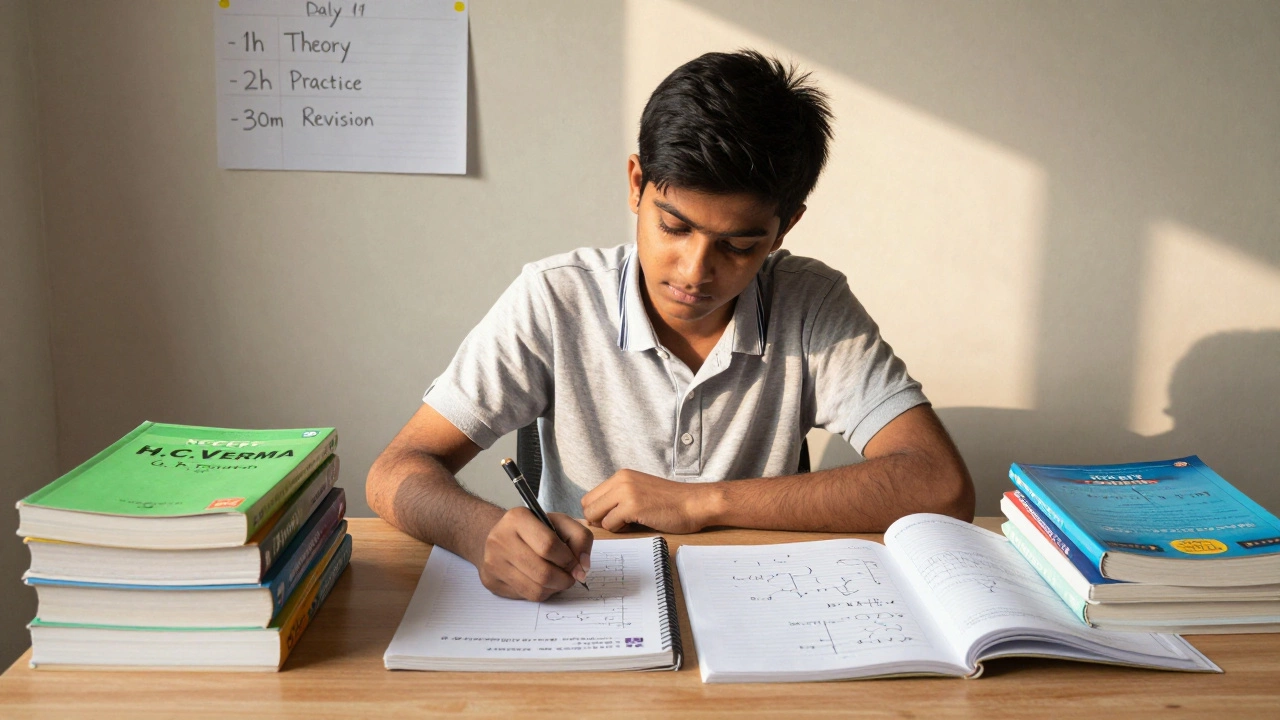
Starting IIT JEE preparation can feel overwhelming. You’ve heard stories of students studying 12 hours a day, cracking 99th percentile scores, and landing into top IITs. But here’s the truth: IIT JEE preparation isn’t about how many hours you log-it’s about how smartly you use them. If you’re just beginning, this guide cuts through the noise and gives you a clear, step-by-step path to build real momentum without burnout.
Understand What IIT JEE Really Is
IIT JEE isn’t one exam. It’s two stages: JEE Main and JEE Advanced. JEE Main is your gateway to NITs, IIITs, and other GFTIs. Clearing it also qualifies you for JEE Advanced, which is the final hurdle to get into any of the 23 IITs. The syllabus is heavy: Physics, Chemistry, and Mathematics-all based on Class 11 and 12 CBSE curriculum but tested at a much deeper level.Most students fail not because they’re not smart, but because they treat JEE like a school exam. It’s not. Questions are application-based, tricky, and often combine multiple concepts. A typical JEE Main question might ask you to find the velocity of a block sliding down an inclined plane with friction-using Newton’s laws, energy conservation, and trigonometry-all in one problem. You need to think like a problem-solver, not a memorizer.
Start with the Right Mindset
You don’t need to be a genius. You need consistency. I’ve seen students with average school grades crack JEE because they showed up every day. Others with top school ranks burned out in six months because they thought cramming was the answer.Here’s the reality: If you study 4 focused hours a day, 6 days a week, for 18 months, you’ll outperform someone who studies 8 hours a day but skips weekends and takes 3-day breaks after every test. Progress isn’t linear. Some weeks you’ll feel stuck. That’s normal. The key is to keep moving.
Build Your Foundation Before Jumping Into Coaching
Many students rush into coaching institutes without fixing basics. If you don’t understand what a derivative is in Math, or how a capacitor stores charge in Physics, coaching classes will only confuse you more.Start here:
- Go through NCERT textbooks for Class 11 and 12. Read them like a story-not just to solve exercises, but to understand the logic.
- For Physics: Focus on mechanics, thermodynamics, and electricity. These make up 60% of JEE Main.
- For Chemistry: Organic reactions are 40% of the paper. Learn mechanisms, not just names. Inorganic? Memorize periodic trends and exceptions.
- For Math: Master algebra, coordinate geometry, and calculus. These are your highest-scoring areas.
Don’t buy 10 books. Stick to NCERT + one good reference book per subject. For Physics, use H.C. Verma. For Chemistry, use O.P. Tandon. For Math, use R.D. Sharma. That’s enough to start.
Create a Realistic Study Plan (No Fluff)
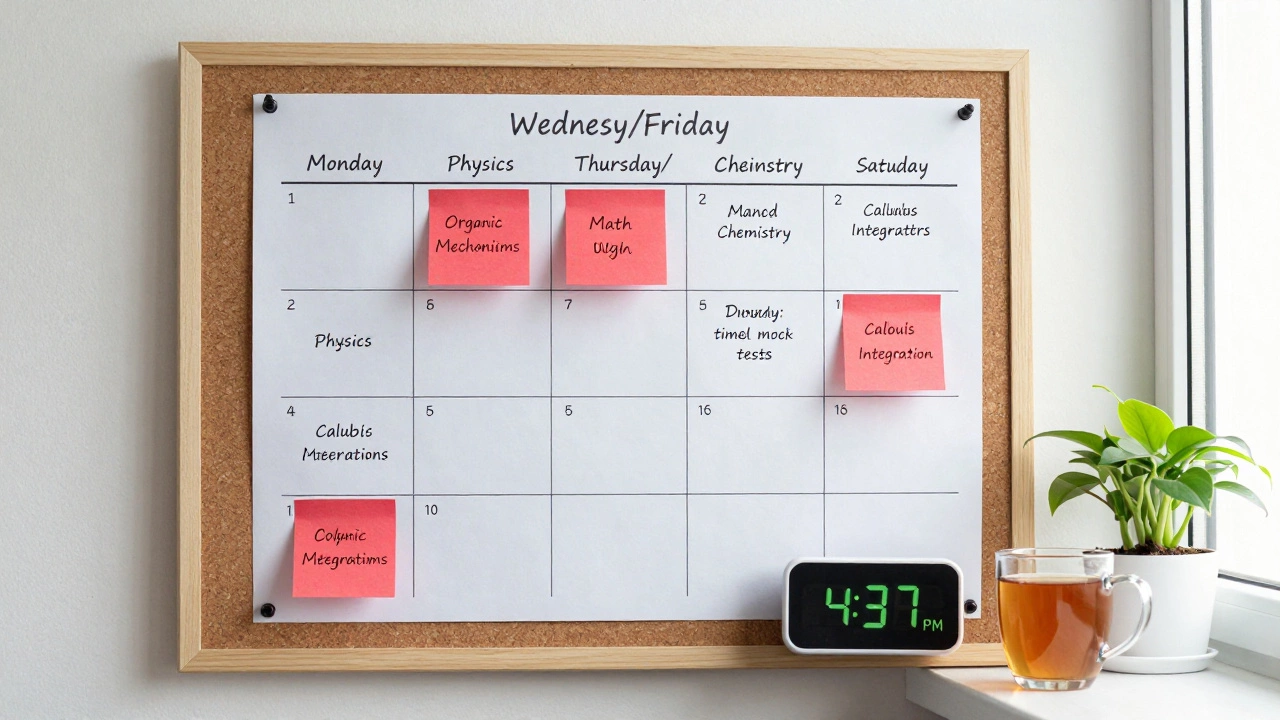
A good plan doesn’t have 100 tasks. It has 3 daily habits:- 1 hour of theory (read, understand, write notes)
- 2 hours of practice (solve problems, no distractions)
- 30 minutes of revision (go over yesterday’s mistakes)
Break your week like this:
- Monday, Wednesday, Friday: Focus on one subject (e.g., Physics)
- Tuesday, Thursday: Alternate between Math and Chemistry
- Saturday: Full-length practice test (timed, no phone)
- Sunday: Review test + weak topic deep dive
Start with 60% of time on weak areas. Don’t waste time on what you already know. If you’re good at Math but struggle with Organic Chemistry, spend 70% of your Chemistry time on reactions and mechanisms.
Use Practice Tests the Right Way
Taking tests every week sounds smart. But if you’re just ticking answers without analyzing why you got something wrong, you’re wasting time.After every test:
- Write down every mistake in a notebook. Label it: "Why I got it wrong"
- Was it a calculation error? Concept gap? Misread question? Speed issue?
- Re-solve the question without looking at the solution. If you can’t, go back to your notes.
Track your progress monthly. If your accuracy in Physics stays below 65% after 3 tests, you need to revisit fundamentals-not do more questions.
Stop Comparing Yourself to Others
You’ll see someone on YouTube who solved 50 problems in 20 minutes. You’ll hear about a friend who cleared JEE Main in 6 months. Don’t fall for it.Everyone starts at a different point. One student might have learned calculus in Grade 9. Another might be seeing integration for the first time in Grade 11. That’s okay. Your journey is yours alone.
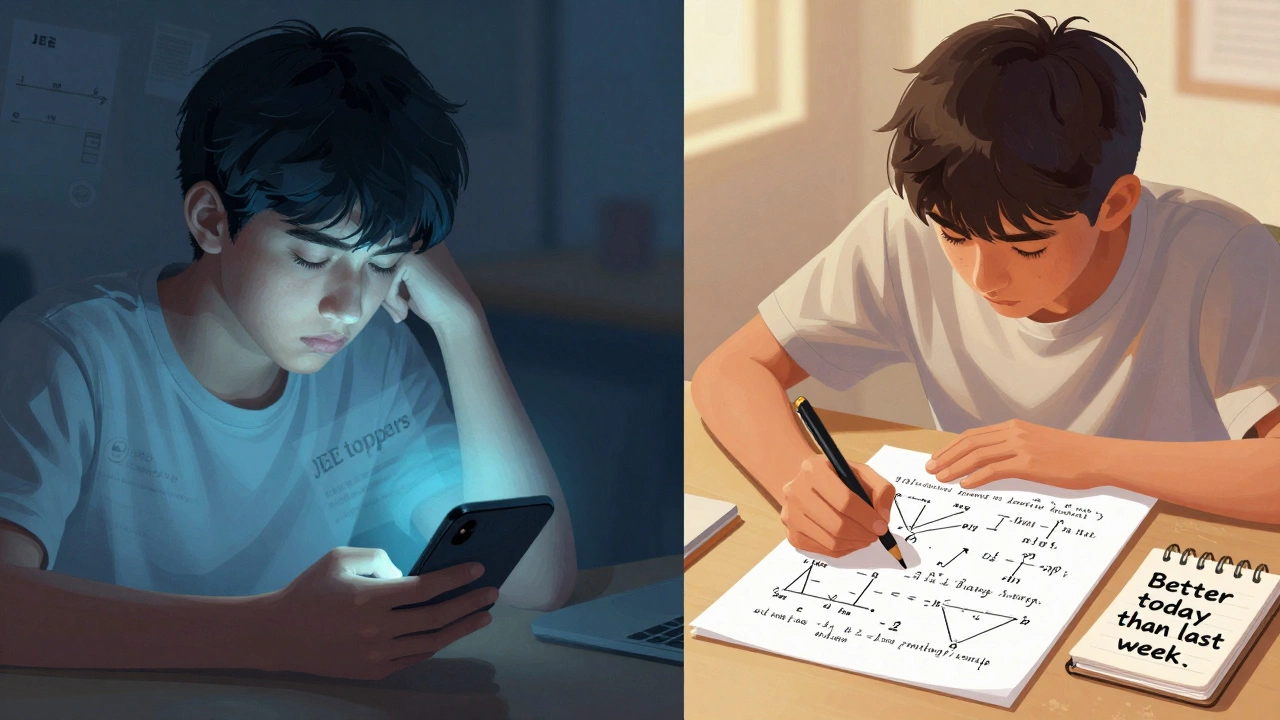
Focus on this metric: Are you better today than you were last week? If yes, you’re winning.
Manage Your Mental Health
Burnout is the #1 reason students quit. If you’re exhausted, stressed, or crying over a wrong answer, you’re not studying harder-you’re studying wrong.Do this:
- Get 7 hours of sleep. No exceptions.
- Take one full day off every 10 days. Go for a walk. Watch a movie. Call a friend.
- Move your body. Even 20 minutes of stretching or a quick jog helps your brain reset.
- Stop using social media during study hours. Use apps like Forest or Focus To-Do to block distractions.
There’s no trophy for studying 18 hours a day. There’s only a broken mind and a failed exam.
When to Start Coaching?
You don’t need coaching to crack JEE. But if you’re struggling with self-study, coaching can help. Choose wisely:- Don’t join a coaching center just because your friends are.
- Look for teachers who explain concepts clearly-not those who brag about their past results.
- Ask: "Do they give feedback on my mistakes?" If yes, it’s worth it.
- Online platforms like Unacademy, BYJU’S, or Physics Wallah offer structured content. Use them as supplements, not crutches.
Coaching is a tool. You’re the driver.
Final Checklist: Are You Ready to Start?
Before you begin, ask yourself:- Do I have NCERT books for Physics, Chemistry, and Math?
- Do I have a quiet place to study without phone distractions?
- Do I know my weak subject?
- Can I commit to 4 focused hours a day for the next 18 months?
If you answered yes to all, you’re ready. Start tomorrow. Not next week. Not after the holidays.
One step today beats ten steps tomorrow.
Can I start IIT JEE preparation in Class 11?
Yes, Class 11 is the ideal time to start. The JEE syllabus is based on Class 11 and 12, so beginning early gives you time to build deep understanding. Most top rankers start in Class 11. Focus on mastering NCERT first, then move to advanced problems. Don’t rush into coaching-build your foundation.
Is coaching necessary to crack IIT JEE?
No, coaching is not necessary. Many students crack JEE with self-study using NCERT, reference books, and online resources. Coaching helps if you need structure, doubt-clearing, or test series. But if you’re disciplined, you can do it alone. The key is consistent practice and smart revision-not the name of the institute.
How many hours should I study daily for IIT JEE?
Focus on quality, not quantity. Four focused hours a day, 6 days a week, is more effective than 8 hours of distracted study. Include theory, practice, and revision. If you’re in Class 11, aim for 4-5 hours. In Class 12, increase to 5-6 hours. Sleep and breaks are part of the schedule-don’t skip them.
Which books should I use for IIT JEE preparation?
Start with NCERT for all subjects. Then use H.C. Verma for Physics, O.P. Tandon for Chemistry, and R.D. Sharma for Mathematics. These are enough to build a strong foundation. Avoid buying 10 books. Master 3. Solve problems repeatedly. Depth beats breadth every time.
Can I crack IIT JEE if I’m weak in Math?
Yes, but you’ll need to work smarter. Math is the most scoring section in JEE. Start with basics: algebra, quadratic equations, and coordinate geometry. Practice daily. Use solved examples to understand patterns. Don’t skip topics just because they’re hard. Weaknesses become strengths with consistent effort. Track your progress weekly.