JEE Subject Strategy & Rank Estimator
Configuration
Analysis
Within limits.
Strategy Tip:
Adjust sliders to see personalized advice.
You’re staring at three massive textbooks. One is thick with formulas that seem to defy logic (Physics). Another is a maze of organic reactions and memorization traps (Chemistry). The third is full of abstract problems that require pure mental gymnastics (Mathematics). You ask yourself: "Which IIT subject is best?"
Here is the hard truth: there is no single "best" subject for the IIT JEE is India's premier engineering entrance examination conducted by the National Testing Agency (NTA) for JEE Main and the Indian Institutes of Technology (IITs) for JEE Advanced.. If you neglect one, your rank will suffer. However, some subjects are easier to score high in, while others offer better differentiation from the crowd.
The goal isn't just to pass; it's to crack the top ranks. To do that, you need to understand which subject gives you the most marks for the least amount of time invested, and which one requires deep conceptual mastery. Let’s break down the reality of Physics, Chemistry, and Mathematics so you can build a winning strategy.
The Reality of Physics: Concept Over Calculation
Many students fear Physics because they think it requires genius-level intuition. It doesn’t. It requires understanding how the world works. In the context of JEE, JEE Physics is the branch of science tested in the exam focusing on mechanics, electromagnetism, thermodynamics, and modern physics. acts as the great equalizer. Unlike Mathematics, where a small calculation error ruins the answer, Physics often allows you to eliminate wrong options through dimensional analysis or logical reasoning.
Why is Physics often considered the "best" subject for scoring?
- Predictable Patterns: Questions in topics like Mechanics and Electrodynamics follow specific patterns. Once you solve 50 variations of a block-on-incline problem, you recognize the template instantly.
- Direct Application: You don’t need to memorize hundreds of derivations. You need to understand Newton’s Laws and apply them. If you know the concept, you can derive the formula on the spot if needed.
- High Weightage Topics: Mechanics alone contributes nearly 30-35% of the paper. Mastering this one area guarantees a solid base score.
The trap? Getting stuck on long calculations. In JEE Advanced, numerical value questions test your precision. If you rush, you lose marks. The strategy here is speed through accuracy, not speed through guessing.
Chemistry: The Score Booster You Can’t Ignore
If Physics is the brain, Chemistry is the heart of your JEE preparation. Many students underestimate it, thinking it’s just rote learning. This is a mistake. JEE Chemistry is divided into Physical, Organic, and Inorganic chemistry, testing both conceptual understanding and factual recall. is widely regarded as the easiest section to secure full marks in, provided you have discipline.
Let’s look at why Chemistry might be the "best" subject for maximizing your percentile:
- Inorganic Chemistry: This is pure memory work. NCERT books are your bible here. If you read the chapters on Coordination Compounds or Chemical Bonding ten times, you will likely get every question right. It’s low effort, high reward.
- Organic Chemistry: This tests logic. Understanding electron movement (GOC - General Organic Chemistry) unlocks the entire section. It’s like learning the grammar of a language. Once you know the rules, you can predict any reaction.
- Physical Chemistry: This is essentially applied mathematics. If you are good at Math, this section will feel familiar. Thermodynamics and Electrochemistry are formula-heavy but straightforward.
The risk? Complacency. Students spend too much time on Physics and Math and skim through Chemistry. They end up losing easy marks. Don’t let this happen. Treat Chemistry as your safety net.
Mathematics: The Rank Decider
Now, let’s talk about the elephant in the room. For many aspirants, JEE Mathematics is a challenging section covering algebra, calculus, coordinate geometry, and trigonometry, known for its complexity and time-consuming nature. is the hardest subject. It has the widest range of difficulty levels. In JEE Advanced, Math can make or break your admission chances.
Is it the "best" subject? Only if you love solving puzzles. Here’s the breakdown:
- Time Consumption: Math questions take longer to solve than Physics or Chemistry. A single Calculus problem might require 5-7 minutes of intense focus. If you get stuck, you lose significant time.
- Vast Syllabus: There are too many topics. From Vectors to Probability, each topic feels different. You can’t rely on a single trick to solve everything.
- Differentiation Power: Because it’s hard, fewer students score well here. If you master Integration or Coordinate Geometry, you stand out. Your rank improves not because you scored higher than everyone else, but because everyone else failed these questions.
The strategy for Math is selective preparation. Don’t try to master every sub-topic equally. Identify your strengths-say, Algebra-and dominate those areas. Leave the extremely obscure topics if they drain your time without yielding results.
Comparing the Subjects: Where Should You Focus?
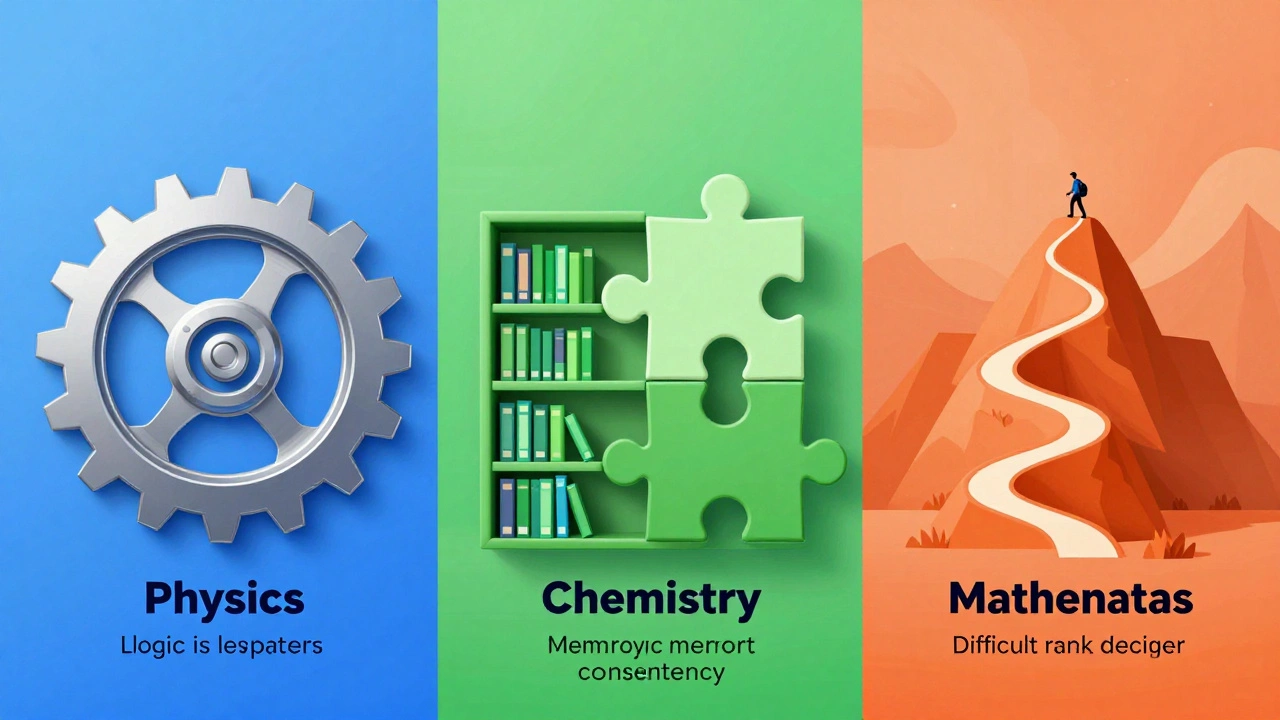
To decide which subject deserves more of your attention, you need to look at the data. Here is a comparison based on typical student performance and exam trends.
| Subject | Difficulty Level | Time Required per Question | Key Strength Needed | Best For... |
|---|---|---|---|---|
| Physics | Moderate | 4-6 minutes | Conceptual Clarity | Logical thinkers who dislike memorization |
| Chemistry | Low to Moderate | 2-4 minutes | Consistency & Memory | Students seeking quick marks and stability |
| Mathematics | High | 6-8 minutes | Practice & Speed | Problem solvers aiming for top 1k ranks |
Notice the time difference? Chemistry is fast. Math is slow. If you run out of time in the exam, it’s usually because you spent too long on a tough Math problem. That’s why smart candidates use Chemistry to buy time for Physics and Math.
How to Choose Your Preparation Order
You asked which subject is best. The answer depends on your current skill set. Here is a decision tree to help you prioritize:
- If you are weak in basics: Start with Chemistry. It builds confidence. Scoring 90+ in Chemistry makes you feel invincible, which helps tackle the harder subjects later.
- If you are good at logic but hate memorization: Focus on Physics first. It aligns with natural reasoning. Use Physics scores to carry your overall rank.
- If you are already strong in all three: Attack Mathematics. This is where the elite ranks are decided. Spend 40% of your study time here.
Don’t ignore the "best" subject myth. The best subject is the one you can solve accurately under pressure. If you panic during Math, then Math is your worst enemy, regardless of its potential marks.
Common Mistakes Students Make
I’ve seen thousands of students fail not because they didn’t study, but because they studied the wrong way. Avoid these pitfalls:
- Ignoring NCERT for Chemistry: No matter how advanced you think you are, JEE questions often come directly from NCERT lines, especially in Inorganic Chemistry. Skipping this is suicide.
- Over-practicing Easy Math Problems: Solving basic integration problems won’t help in JEE Advanced. You need to practice complex, multi-concept problems.
- Neglecting Mock Tests: Theory is useless without application. Take full-length mock tests weekly. Analyze why you got questions wrong. Was it a concept gap or a silly mistake?
Remember, consistency beats intensity. Studying 6 hours daily for a year is better than studying 15 hours for a month and burning out.
Final Thoughts on Strategy
So, which IIT subject is best? Chemistry is best for securing marks. Physics is best for building a foundation. Mathematics is best for climbing the ranks. You need all three, but you should approach them differently.
Treat Chemistry as your guaranteed income. Treat Physics as your steady growth. Treat Mathematics as your high-risk, high-reward investment. Balance your portfolio, and you’ll crack the code.
Is Physics or Math easier in JEE?
For most students, Physics is considered easier than Math because it relies more on conceptual understanding and less on complex calculations. However, if you have strong mathematical skills, you might find Physical Chemistry and certain parts of Physics intuitive. Math is generally harder due to its vast syllabus and time-consuming nature.
Can I skip Inorganic Chemistry for JEE?
Absolutely not. Inorganic Chemistry carries significant weightage and consists of direct questions from NCERT textbooks. Skipping it means leaving free marks on the table. It requires consistent reading rather than deep problem-solving, making it a high-return investment of your time.
Which subject has the highest weightage in JEE Advanced?
All three subjects-Physics, Chemistry, and Mathematics-have equal weightage in terms of marks (usually 100 marks each in the main paper). However, the number of questions and their difficulty distribution may vary slightly by year. You cannot afford to neglect any single subject.
How many hours should I dedicate to each subject daily?
A balanced approach is recommended. If you study 8 hours a day, consider splitting it as 3 hours for Math, 3 hours for Physics, and 2 hours for Chemistry. Adjust this based on your weak areas. If Math is your weakness, increase its share temporarily until you gain confidence.
Is it possible to crack IIT with only two subjects?
It is highly unlikely. While you might get a decent rank by excelling in two subjects, the competition is fierce. Top IITs require near-perfect scores across all three sections. Neglecting one subject creates a ceiling on your maximum possible score, preventing you from reaching the top percentiles.