
Exam Competition & Odds Calculator
Use this tool to understand the "Numbers Game." Enter the total number of applicants and the available seats to see the selection ratio and your statistical odds.
Your Odds: 0%
This means approximately 1 out of every 0 candidates will succeed.
Главные Takeaways
- Competition is measured by the "selection ratio" (seats vs. applicants), not just the difficulty of the questions.
- The Gaokao and UPSC are widely considered the most grueling globally.
- Psychological endurance and strategic planning often matter more than raw IQ.
- Different exams test different things: some want specialists, others want generalists who can multitask under pressure.
The Numbers Game: What Actually Makes an Exam Competitive?
When people ask which exam is the most competitive, they usually mean "where are my odds the lowest?" Difficulty is subjective. A physics problem might be hard for one person, but if 10,000 people apply for 10 seats, the most competitive exams are defined by the sheer volume of competition. This is the selection ratio.
Take the UPSC Civil Services Examination in India. It's not just that the syllabus is massive; it's that you're competing against nearly a million candidates for a few thousand positions in the Indian Administrative Service (IAS). The success rate is often less than 1%. When you're fighting for a spot where 99% of people will fail regardless of how hard they study, that's where true competition lives.
The Titans of Competition: A Global Comparison
Different countries have their own "ultimate" tests. Some are designed to filter for intelligence, others for discipline, and some for sheer mental stamina.
In China, the Gaokao is essentially a national event. It's the university entrance exam that determines if a student gets into a top-tier school like Tsinghua or Peking University. The pressure is so high that the government implements strict security-including drones-to prevent cheating. If you fail the Gaokao, your path to a high-status career in the Chinese bureaucracy or corporate world becomes significantly harder. It's less about a specific subject and more about a total academic survival test.
Then there's the JEE Advanced (Joint Entrance Examination), which is the gateway to the Indian Institutes of Technology (IITs). Unlike general exams, the JEE is a brutal filter for STEM capability. It doesn't ask you to memorize; it asks you to apply complex concepts to problems you've never seen before. The competitive nature here comes from the fact that the top 1% of the smartest students in the country are all fighting for the same few thousand seats.
| Exam Name | Primary Goal | Key Difficulty Factor | Estimated Success Rate |
|---|---|---|---|
| UPSC (India) | Govt. Administration | Vast Syllabus / Low Vacancies | < 1% |
| Gaokao (China) | University Entry | Extreme Pressure / Volume | Variable by Tier |
| JEE Advanced (India) | Engineering (IIT) | Complex Problem Solving | ~ 1-2% |
| CSAT (South Korea) | University Entry | Social Pressure / Timing | High Competition for SKY |
| MCAT (USA/Canada) | Medical School | Prerequisite Rigor | Moderate to High |
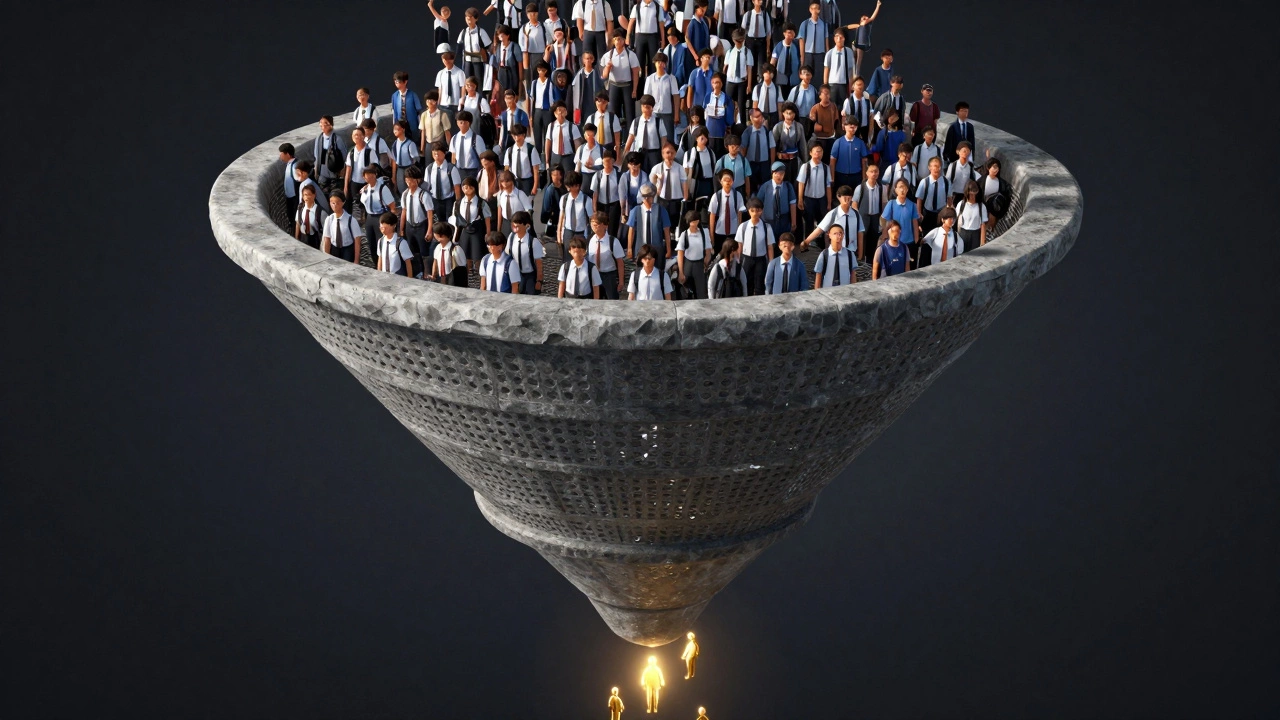
The Psychological Toll of the "Sieve"
Competitive exams aren't just academic tests; they are psychological sieves. They are designed to break people. When you spend two to three years in a "coaching hub" like Kota in India or a "hagwon" in South Korea, your entire identity becomes tied to a rank. If you are rank 500, you are a success; if you are rank 5,001, you might feel like a failure.
This creates a strange paradox. The most competitive exams often lead to a "diminishing returns" effect. When everyone is studying 16 hours a day, the edge doesn't come from studying more-it comes from studying smarter. This is why strategy, such as using Active Recall and Spaced Repetition, becomes the real competitive advantage.
Why Do We Have These Brutal Systems?
You might wonder why any society would subject its youth to this. The answer is simple: scarcity. When there are only a few prestigious jobs or universities but millions of capable people, a standardized test is seen as the "fairest" way to decide. It removes bias (theoretically) and replaces it with a hard number.
However, this system often ignores soft skills. Someone might be the top scorer in the SAT or GRE but struggle to lead a team or think creatively. The competition is so focused on the "correct answer" that it accidentally punishes the risk-takers.

How to Survive a High-Competition Exam
If you're currently staring down one of these giants, you need more than just a textbook. You need a survival plan. The people who win these exams usually follow a few specific rules of thumb:
- Analyze the Weightage: Don't treat every chapter as equal. Figure out which topics appear most frequently and master those first.
- Simulate the Stress: Studying in a quiet library is great, but you need to take full-length mock tests in a noisy or timed environment to build "exam stamina."
- Manage the "Dip": There is always a point, usually 3-6 months in, where your motivation crashes. Expect it. Plan for a break before the crash happens.
- Focus on Accuracy over Speed: In exams like the JEE, negative marking can kill your rank. It's better to answer 60 questions correctly than 90 questions with 30 errors.
Looking Beyond the Rank
The most dangerous thing about the most competitive exams is the belief that the exam is the only path to success. While getting into an IIT or becoming an IAS officer provides a massive head start, the real world values adaptability more than the ability to memorize a syllabus.
We're seeing a shift. Some companies are moving away from GPA and test scores toward skill-based hiring and portfolios. The "most competitive" exam in the long run is actually the one where you learn how to learn. If you can master the discipline required for the Gaokao or the UPSC, you've developed a level of grit that will serve you well regardless of whether you passed the test or not.
Is the UPSC harder than the JEE?
It depends on your strengths. The JEE is more "technically" difficult, requiring deep mastery of Physics, Chemistry, and Math. The UPSC is "operationally" more difficult because the syllabus is vast (History, Geography, Polity, Current Affairs) and the selection ratio is significantly lower. JEE tests your brain's processing power; UPSC tests your endurance and breadth of knowledge.
What is the hardest exam in the world?
While subjective, the Gaokao in China and the UPSC in India are frequently cited as the hardest due to the combination of extreme syllabus depth and the sheer number of candidates competing for a tiny number of spots. Some also point to the Master Sommelier exam for its incredibly low pass rate and sensory precision requirements.
Does a high rank always guarantee a good career?
A high rank opens the door to the best institutions and networking opportunities, which is a huge advantage. However, it doesn't guarantee success. Professional growth depends on emotional intelligence, leadership, and the ability to adapt-traits that these exams rarely measure.
How can I handle the stress of competitive exams?
The key is breaking the goal down. Instead of worrying about the "final rank," focus on daily targets. Maintain a strict sleep schedule-sleep deprivation actually impairs the memory consolidation you need for these exams. Physical exercise, even a 20-minute walk, helps clear the cortisol buildup from stress.
Why are success rates for these exams so low?
It's a matter of capacity. Institutions like IITs or government bodies have a fixed number of seats or roles based on budget and infrastructure. When the population grows but the number of "elite" spots doesn't, the success rate naturally drops, making the exam more competitive.