Board Preparation Effort Calculator
This tool estimates relative preparation effort needed for competitive exams like JEE and NEET based on your education board and current grade. Results show how your board compares to others in the Indian education system.
If you’ve ever heard someone say, CBSE is the hardest board in the world, they’re not just being dramatic. Millions of Indian students face this system every year, and the pressure doesn’t come from the number of chapters-it comes from how deeply they’re expected to understand them. CBSE isn’t just a curriculum. It’s a gatekeeper to engineering, medicine, and national-level exams. But is it really the hardest? Or is it just the most demanding?
Why CBSE Feels Like the Toughest Board
CBSE, or the Central Board of Secondary Education, covers over 20,000 schools across India and abroad. Its syllabus is designed with one goal: to prepare students for competitive exams like JEE, NEET, and NTSE. That means every topic in Physics, Chemistry, and Math isn’t just taught-it’s drilled. In Class 10, students tackle quadratic equations and trigonometry with the same intensity as Class 12 students. By Class 11, they’re already solving calculus problems that many international curricula save for university.
The exam pattern doesn’t help either. CBSE papers are known for their precision. A single calculation error can cost you 2-3 marks. There’s no room for vague answers. In Science subjects, you’re expected to write exact formulas, draw perfect diagrams, and label every part correctly. In English, the writing section isn’t about creativity-it’s about structure. You lose marks if you miss a single transition word.
Compare that to state boards like Maharashtra or Uttar Pradesh, where questions are often direct, and rote learning can carry you through. CBSE doesn’t reward memorization. It rewards understanding.
How ICSE Compares
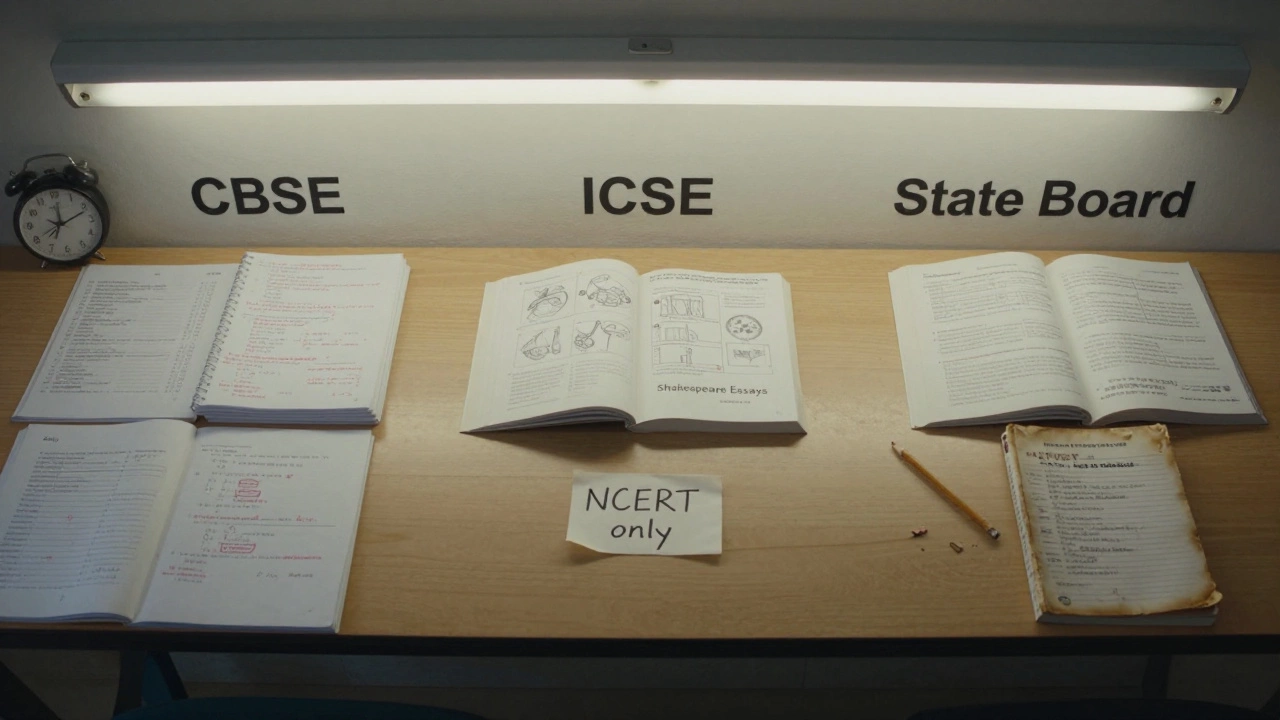
Many assume ICSE (Indian Certificate of Secondary Education) is harder because it has more subjects and longer papers. And technically, that’s true. ICSE requires students to study 10 subjects in Class 10, including Environmental Science and Computer Applications. The English paper is longer, the literature section is more detailed, and the internal assessments are stricter.
But here’s the catch: ICSE doesn’t push students toward national entrance exams. Its focus is on holistic learning. You’ll learn about Shakespeare in depth, write essays on social issues, and study biology with more emphasis on diagrams and processes. But you won’t get the same level of problem-solving intensity in Math and Physics that CBSE gives you.
So while ICSE feels heavier in volume, CBSE feels heavier in pressure. One is broad. The other is deep.
State Boards: Easier on Paper, Harder in Reality
State boards like Tamil Nadu, Karnataka, or Bihar are often called easier. And for good reason. Their syllabi are shorter. Questions are repetitive. Passing rates are higher. Many students from these boards switch to CBSE for Class 11 just to compete for JEE or NEET.
But here’s what people forget: ease doesn’t mean low stakes. In rural areas, students from state boards often lack access to quality coaching, study material, or even reliable internet. So while the board might be easier, the system around it isn’t. A student from a small town in Odisha trying to crack NEET with a state board background is fighting an uphill battle-not because the board is hard, but because the support system isn’t built for it.
CBSE, on the other hand, has a nationwide network of coaching centers, sample papers, and digital resources. The board itself releases official sample papers every year. Teachers are trained on the latest marking schemes. It’s not easy-but it’s structured.
The Real Reason CBSE Feels Unbeatable
The hardest board isn’t the one with the most chapters. It’s the one that makes you feel like you’re never good enough.
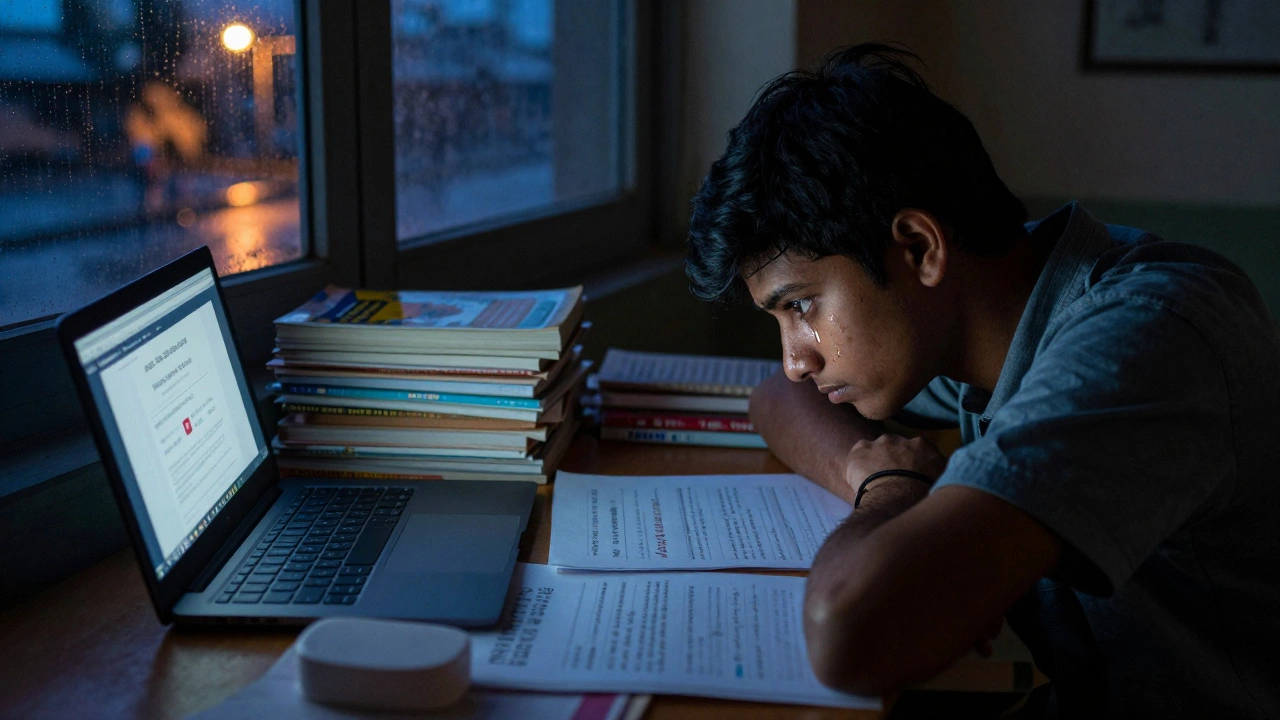
CBSE students start preparing for JEE as early as Class 8. They take mock tests every month. Their schools track their percentile rankings. Parents compare their child’s score with the topper from the next town. The pressure isn’t just academic-it’s social, emotional, and cultural.
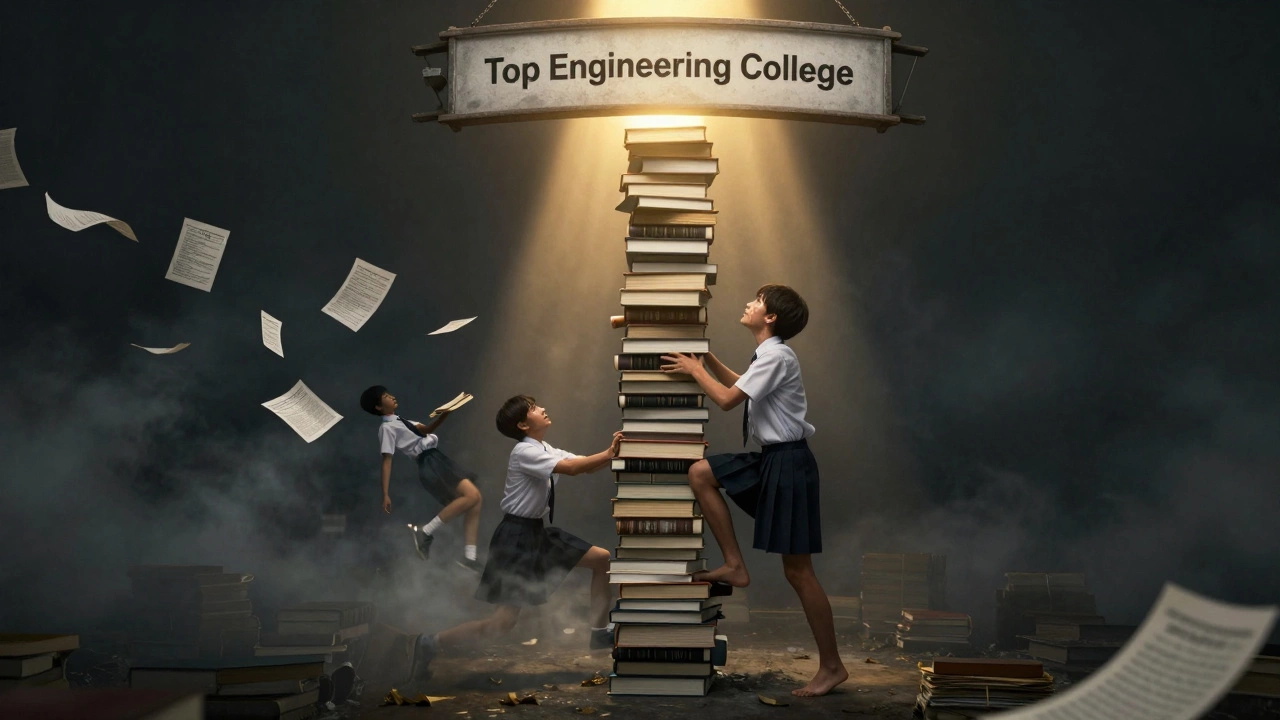
There’s no safety net. If you score 90% in CBSE, you’re still not guaranteed a seat in a top engineering college. You need 98%+ in JEE Main. That’s the reality. No other board in India ties your school performance so tightly to your future.
Even globally, few education systems demand this kind of early specialization. In the U.S., students explore multiple subjects until college. In the UK, A-Levels let you pick 3-4 subjects. In Canada, the curriculum is more flexible. But in India, CBSE forces you to lock in your career path by age 14.
Is CBSE the Hardest? It Depends on What You Mean by ‘Hard’
If hard means more content, then ICSE wins.
If hard means more pressure, then CBSE wins.
If hard means least margin for error, then CBSE wins again.
There’s no board in the world that connects your 10th-grade marks to your 18-year-old career like CBSE does. It’s not just a curriculum. It’s a pipeline.
And that’s why, for millions of students, CBSE isn’t just the hardest board-it’s the only one that matters.
What Students Actually Struggle With
Let’s break down the real pain points:
- Time crunch: 15 chapters in Physics in Class 11, all exam-focused. No time for curiosity.
- Marking strictness: Even if your answer is correct, you lose marks for not writing the formula first.
- Resource inequality: Students in private schools get coaching. Public school students get NCERT books and YouTube.
- Parental expectations: A 90% score is seen as a failure if the topper got 98%.
- Lack of creativity: Writing answers in bullet points, following rigid formats, kills original thinking.
These aren’t flaws in the syllabus. They’re features of a system built for competition, not curiosity.
Can You Succeed Without CBSE?
Yes. But it’s harder.
Students from ICSE or state boards who crack JEE or NEET do so by switching to CBSE-style coaching after Class 10. They buy CBSE-specific reference books. They solve past CBSE papers. They learn the language of the exam-even if their board didn’t teach it.
There’s no official advantage. Just a cultural one: CBSE is the default path. Everything else requires extra work.
What the Future Holds
The National Education Policy 2020 promised flexibility. It talked about reducing syllabus load and encouraging critical thinking. But in practice, CBSE still runs on the same engine. The 2025 sample papers for Class 10 Math still have 4-mark word problems that require 6-step solutions. The Physics practical exams still demand exact measurements to two decimal places.
Change is slow. And until the entrance exams change, CBSE won’t change either.
So if you’re asking, Is CBSE the hardest board in the world?-the answer isn’t about syllabus length or exam difficulty. It’s about what’s expected of you. And right now, no other board asks students to carry that kind of weight so early.
Is CBSE harder than ICSE?
CBSE is harder in terms of exam pressure and depth in Science and Math. ICSE has more subjects and longer papers, but it doesn’t push students toward competitive exams like JEE or NEET. CBSE’s structure is designed for high-stakes testing, while ICSE focuses on broader learning.
Which board is best for JEE preparation?
CBSE is the best board for JEE preparation because its syllabus aligns almost perfectly with the JEE Main and Advanced curriculum. Most coaching institutes use NCERT books-published by CBSE-as their base material. Students from CBSE schools typically have an advantage in problem-solving speed and conceptual clarity.
Can a state board student crack NEET?
Yes, but it’s tougher. State board syllabi often cover fewer topics in Biology and Physics, and the depth is lower. Students need to bridge the gap by studying CBSE-level NCERT books, solving previous years’ NEET papers, and joining coaching. Many successful NEET toppers come from state boards, but they usually put in 50-100% more effort than CBSE students.
Why do CBSE students score higher in national exams?
CBSE students score higher because their curriculum is designed to match the pattern and difficulty of national exams. NCERT textbooks are the official source for JEE and NEET questions. CBSE also emphasizes analytical questions over rote memorization, which is exactly what competitive exams test. The system trains students to think like exam setters.
Is CBSE harder than the IB or Cambridge curriculum?
IB and Cambridge are more balanced and less exam-focused. They encourage research, projects, and critical thinking. CBSE is more rigid, with high-stakes final exams that determine your future. In terms of workload and pressure, CBSE is harder. In terms of holistic development, IB and Cambridge are stronger. It’s not about which is better-it’s about what you’re preparing for.
Final Thought: Hard Isn’t Always Better
The hardest board doesn’t mean the best board. It just means the one that demands the most. CBSE is hard because it doesn’t let you hide. You have to be ready-early, often, and without excuses. For some, that’s empowering. For others, it’s exhausting.
There’s no magic formula. Just hard work, clear goals, and the right resources. Whether you’re in CBSE, ICSE, or a state board, your future isn’t decided by the board you’re on. It’s decided by what you do with the time you’re given.