
NEET Preparation Timeline Calculator
Find your optimal preparation schedule based on your current class. The best time to start is Class 9, but we'll help you maximize your potential even if you're starting later.
Key Timeline
Study Time Breakdown
Key Advice:
Thousands of students dream of getting into a top medical college in India. But if you’re serious about cracking NEET, waiting until the last minute won’t cut it. The question isn’t just when to start - it’s how to build momentum so you’re not just studying, but mastering the material.
Start as early as Class 9
Most students think NEET prep begins in Class 11. That’s too late. The truth? The best time to start is Class 9. Why? Because NEET doesn’t just test what you learn in 11th and 12th - it tests how deeply you understand the basics. Physics, chemistry, and biology in Class 11 are built on concepts you first meet in Class 9 and 10. If you didn’t fully grasp how cells divide in biology, or how forces work in physics, you’ll struggle later. Starting early means you can slowly build your foundation without panic. You won’t be cramming formulas the night before a test - you’ll be using them naturally.
Think of it like learning to ride a bike. You don’t hop on a road bike and expect to race in a week. You start with training wheels, then balance, then speed. Same with NEET. Class 9 is your training wheels. Class 10 is your balance phase. By Class 11, you’re already pedaling hard.
Class 10 is your bridge year
If you didn’t start in Class 9, don’t panic. Class 10 is your last clean shot at setting up for success. This is the year to shift your focus. Stop treating science as just another subject. Start seeing it as the language of medicine. Chemistry isn’t just reactions - it’s how drugs work. Biology isn’t just diagrams - it’s how the human body survives. Physics isn’t just formulas - it’s how X-rays and MRIs function.
Use this year to get comfortable with NCERT textbooks. They’re not just for board exams - they’re the blueprint for NEET. Over 80% of NEET questions come directly from NCERT content. If you read, understand, and revise NCERT Class 9 and 10 science books by the end of Class 10, you’re already ahead of 70% of NEET aspirants.
Class 11 is where the real grind begins
This is when most students join coaching. And they’re right to. But coaching alone won’t save you. What matters is how you use it. Many students think attending 6 hours of class a day is enough. It’s not. Coaching gives you structure. But discipline? That’s yours.
Here’s what works: 3 hours of class, 2 hours of self-study, 1 hour of revision. Repeat daily. Don’t wait for weekends to catch up. If you miss one day, you fall behind. By the end of Class 11, you should have finished the entire syllabus at least once. That’s not optional - it’s the baseline.
Also, start taking small tests every week. Not full mocks. Just 15-20 questions on what you learned that week. Track your weak spots. If you keep missing questions on photosynthesis or Newton’s laws, go back. Don’t move on until you’ve fixed it.
Class 12 is about refinement, not learning
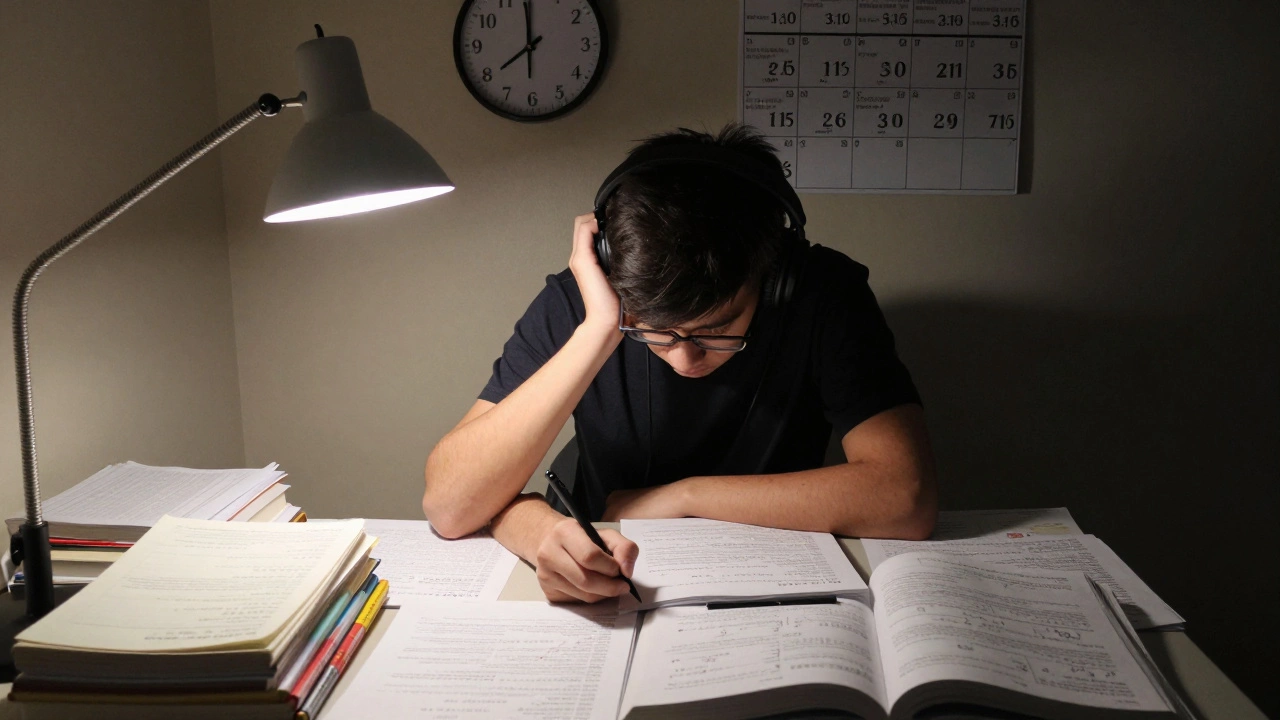
In Class 12, you’re not supposed to learn new concepts. You’re supposed to sharpen what you already know. This is the time to focus on speed, accuracy, and exam strategy. You should be doing 2 full-length mock tests every week. Time yourself. No breaks. No distractions. Treat each test like the real NEET.
Review every mistake. Not just the answer - why you got it wrong. Did you misread the question? Forget a formula? Get confused between similar terms like “mitosis” and “meiosis”? Write it down. Keep a mistake journal. It’s your personal cheat sheet for what to avoid on exam day.
By December of Class 12, you should be consistently scoring above 600 in mocks. If you’re not, you need to adjust. Maybe your biology revision is weak. Maybe you’re skipping chemistry practice. Don’t ignore the signs.
What about students who start late?
You’re not alone. Many students start in Class 11, some even in Class 12. It’s harder, but not impossible. If you’re starting in Class 11, you need to compress your timeline. Aim to finish the Class 11 syllabus in 4 months. Then Class 12 in another 5. That’s aggressive - but doable if you study 8-10 hours a day, with zero distractions.
If you’re starting in Class 12? You’re in survival mode. Focus only on high-yield topics. In biology, prioritize human physiology, genetics, and reproduction. In chemistry, focus on organic reactions and chemical bonding. In physics, nail down electromagnetism, optics, and modern physics. Skip the deep dives. You need breadth, not depth.
But here’s the hard truth: students who start late rarely top the exam. They scrape through. If you want to get into AIIMS or JIPMER, you need to be in the top 1%. That doesn’t happen with last-minute effort.
What about weekends and holidays?
Weekends aren’t for sleeping in. They’re for testing yourself. Use Saturday to take a mock test. Sunday to review it. No social media. No YouTube. Just you, your notes, and your mistakes.
Holidays? Use them. If you get a 10-day break after exams, don’t go on vacation. Use 7 days to revise one subject. That’s 20 hours of focused revision. That’s 200 extra questions you’ve practiced. That’s 200 more chances to avoid mistakes on exam day.

Coaching matters - but only if you do your part
Coaching centers give you materials, tests, and teachers. But they don’t make you study. You do. The best coaching in Delhi won’t help if you’re scrolling through Instagram during lecture breaks. The most expensive online course won’t work if you skip practice sessions.
Coaching is a tool. Discipline is the engine. Pick one good coaching center. Stick with it. Don’t jump between institutes. Consistency beats variety every time.
What’s the magic number?
There’s no secret formula. But here’s what top scorers do:
- Complete NCERT Class 9-12 biology, chemistry, and physics at least 3 times
- Take 100+ full mocks before NEET
- Spend 60% of study time on practice, not theory
- Revise weak topics every week
- Never skip sleep before the exam
If you follow this, you’re not just preparing for NEET - you’re building the mindset of a doctor.
Final thought: It’s not about when you start - it’s about how you show up
Some students start in Class 9 and burn out by Class 11. Others start in Class 12 and crush it. It’s not about the calendar. It’s about consistency. It’s about showing up every day, even when you’re tired. Even when you feel like giving up.
NEET isn’t a test of how smart you are. It’s a test of how stubborn you are. The best time to start? Yesterday. But if you missed that? Today is still perfect.
Can I prepare for NEET without coaching?
Yes, you can. Many top scorers have done it. But it requires extreme discipline. You need a strict schedule, access to quality study material (NCERT, previous papers, reliable online videos), and the ability to self-assess. Without coaching, you won’t get regular feedback or mock tests unless you create them yourself. Coaching gives structure - but if you can build that structure on your own, you don’t need it.
Is Class 11 too late to start NEET prep?
No, Class 11 is not too late - but it’s tight. You’ll need to finish the entire Class 11 syllabus in 5-6 months, then move to Class 12. That means 8-10 hours of study daily, with zero distractions. You’ll have to skip social events, limit screen time, and treat every day like a race. It’s possible - but only if you’re fully committed. Most students who start in Class 11 make it into medical colleges, but few reach the top ranks.
How many hours should I study daily for NEET?
If you start in Class 9 or 10, 3-4 hours a day is enough. From Class 11 onward, aim for 6-8 hours. In Class 12, increase to 8-10 hours, especially from October. But hours alone don’t matter - focus does. Two hours of deep, distraction-free study beats five hours of scrolling and daydreaming. Track your output, not your clock.
Which subjects are most important for NEET?
Biology carries the most weight - 50% of the paper. You need to master NCERT Biology inside out. Chemistry is next - 25% - with equal focus on organic, inorganic, and physical. Physics is 25%, and while it’s harder for many, it’s easier to score well in if you practice numericals daily. Don’t neglect any subject. A balanced score across all three is what gets you into top colleges.
Should I take NEET in Class 12 or drop a year?
Take it in Class 12 unless your mock scores are consistently below 500. Dropping a year increases pressure, costs money, and delays your career. Most students who drop a year don’t improve as much as they think. If you’re scoring 600+ in mocks by January of Class 12, you’re ready. If you’re below 550, you might benefit from an extra year - but only if you have a clear plan, not just more time.