Exam Success Probability Calculator
How this tool works
Estimate your realistic success probability for India's toughest exams using key preparation metrics. Based on data from the article: 1.5M applicants → 10K seats (IIT JEE), 2.3M applicants → 100K seats (NEET), 1.1M applicants → 900 seats (UPSC).
Note: Calculations are simplified estimates based on published statistics. Success depends on multiple factors beyond preparation time.
Estimated Success Probabilities
Every year, millions of students in India sit for exams that can change their lives. But not all exams are created equal. Some are so hard, so packed with competition, and so high-stakes that they become the stuff of legend. If you’re asking which are the three toughest exams in India, the answer isn’t about difficulty alone-it’s about scale, pressure, and the sheer number of people chasing a tiny slice of success.
IIT JEE: The Engineering Gauntlet
The Joint Entrance Examination for the Indian Institutes of Technology, or IIT JEE, isn’t just an exam-it’s a national ritual. Over 1.5 million students take it every year. Only about 10,000 get into the 23 IITs. That’s less than 1% acceptance rate. The exam tests not just knowledge, but speed, precision, and mental endurance. One wrong move in a 3-hour paper can cost you a seat.
The syllabus covers Physics, Chemistry, and Mathematics at a level far beyond what’s taught in most schools. Students start preparing as early as Class 8. Many spend 12-16 hours a day for two years. Coaching centers in Kota, Delhi, and Hyderabad are packed with teenagers living on energy drinks and sleepless nights.
What makes IIT JEE brutal isn’t just the content. It’s the perception. Getting into an IIT is seen as a ticket to a guaranteed high-paying job, global recognition, and social status. Parents invest lakhs. Students sacrifice hobbies, friendships, and sometimes their mental health. The pressure isn’t just external-it’s internal. You’re not just competing against your peers. You’re competing against the dream of an entire family.
NEET: The Medical Marathon
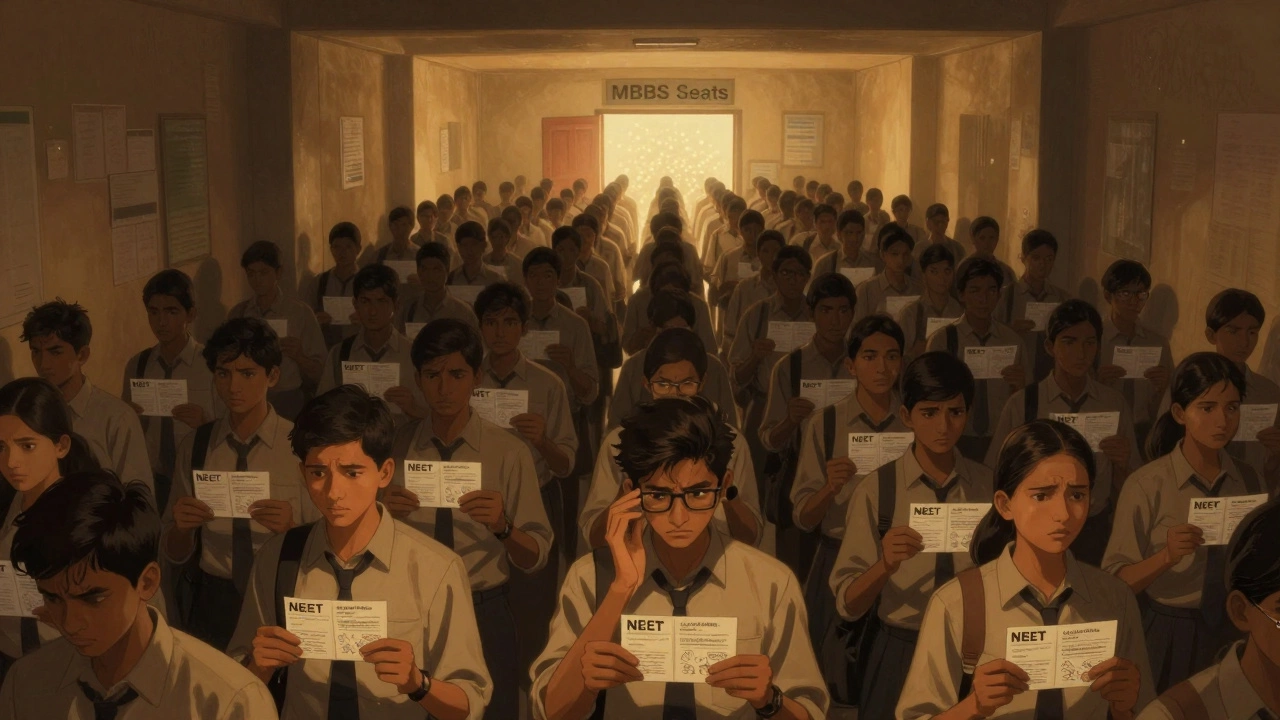
If IIT JEE is the engineering gauntlet, NEET (National Eligibility cum Entrance Test) is the medical marathon. Every year, more than 2.3 million students apply to become doctors. Only around 100,000 get admitted to MBBS programs across India. Of those, less than 20,000 land seats in government medical colleges-the ones with fees under ₹1 lakh per year.
NEET’s syllabus is heavy: Biology (Botany and Zoology), Physics, and Chemistry. But here’s the catch-Biology makes up 50% of the paper. That means you need to memorize thousands of facts: anatomical structures, enzyme names, plant classifications, drug mechanisms. One small mistake in recalling a single detail can drop you 50 ranks.
Unlike IIT JEE, NEET has a huge rural population trying to break into medicine. Many come from villages with no access to quality coaching. They rely on free YouTube videos, second-hand books, and self-study. Yet they’re competing against urban students who’ve spent years in paid coaching institutes with AI-driven mock tests and personalized feedback.
The stakes? A career in medicine. But also survival. In India, a doctor’s income is among the most stable. For families in small towns, one child becoming a doctor means financial security for generations. That’s why NEET isn’t just an exam-it’s a lifeline. And that’s why it’s so terrifying.
UPSC CSE: The Ultimate Test of Power
While IIT JEE and NEET test technical knowledge, the UPSC Civil Services Examination (CSE) tests everything else. It’s not about solving equations or memorizing human organs. It’s about understanding governance, history, economics, ethics, international relations, and current affairs-all while writing clear, structured essays under time pressure.
Over 1.1 million candidates apply each year. Only about 800-1,000 clear the final stage. That’s less than 0.1%. The exam has three stages: Prelims (objective), Mains (written), and the Personality Test (interview). The Mains alone has nine papers-two language papers (qualifying), four General Studies, one Essay, and two Optional Subjects. Optional subjects range from History to Agriculture to Anthropology. You have to pick one and master it like a PhD candidate.
What makes UPSC CSE the toughest? The time. Most aspirants spend 1-3 years preparing full-time. Many quit jobs, sell their cars, move to Delhi, and live on savings. They read newspapers religiously. They annotate 100+ books. They write 10,000+ words of answers every week. And still, 90% fail.
The interview panel doesn’t ask you what you know. They ask you what you think. They test your values, your clarity, your calm under pressure. One candidate was asked: “If you found a wallet with ₹50,000 and no ID, what would you do?” Another was asked: “How would you handle a village that refuses to install toilets?” There’s no right answer. Only a thoughtful one.
UPSC CSE doesn’t just select officers. It selects leaders. And that’s why it’s harder than any other exam in India.
Why These Three Stand Out
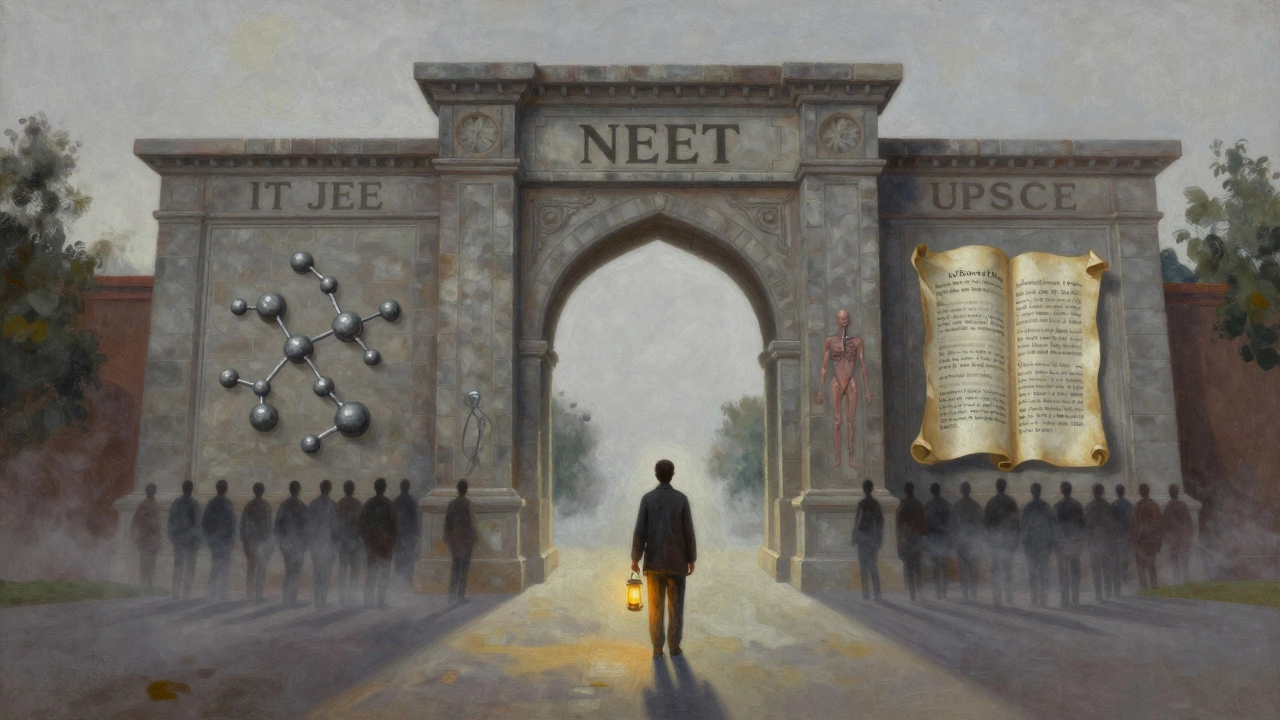
What do IIT JEE, NEET, and UPSC CSE have in common? Three things: scale, stakes, and silence.
Scale: Each draws over a million applicants. No other exam in India comes close. Even state-level exams like WBJEE or MHT-CET have a fraction of the applicants.
Stakes: These exams don’t just decide your college-they decide your career path, your income, your social mobility, and sometimes your family’s future. Fail IIT JEE? You might still get into a good private engineering college. Fail NEET? You might become a pharmacist or go abroad. Fail UPSC? You might try again next year-or switch careers entirely.
Silence: These exams don’t shout. They don’t have flashy ads or influencers promoting them. They just exist. And every year, millions show up anyway. Because in India, success is still measured by these three doors.
What About Other Exams?
People often mention CAT for MBA, CLAT for law, or GATE for postgraduate engineering. These are tough too. CAT has a 3-4% acceptance rate. CLAT is highly competitive for top NLUs. GATE opens doors to PSUs and IISc.
But they don’t have the same cultural weight. CAT is for a specific career track. CLAT is niche. GATE is for those already in engineering. IIT JEE, NEET, and UPSC CSE are the ones every Indian parent talks about. They’re the ones kids grow up hearing about at family dinners. They’re the ones that define what “success” means in a country of 1.4 billion people.
Is There a Way to Prepare Wisely?
Yes. But not by studying more. By studying smarter.
- For IIT JEE: Focus on NCERTs first. Then solve past papers. Don’t jump into advanced books until you’ve mastered the basics.
- For NEET: Biology is your friend. Memorize diagrams. Practice previous years’ questions. Don’t ignore Chemistry-it’s the tiebreaker.
- For UPSC CSE: Read The Hindu daily. Make notes. Don’t collect books-use them. Practice answer writing from Day 1. Mock interviews matter more than you think.
There’s no magic formula. No shortcut. But there is a pattern: consistency beats cramming. Mental health beats burnout. Clarity beats chaos.
Final Thought
These exams aren’t just tests of knowledge. They’re tests of character. They ask: How badly do you want it? Are you willing to wake up at 5 AM for three years? Are you ready to face disappointment and keep going? Can you stay focused when everyone around you is moving on?
If you’re preparing for one of these, you’re not just studying for an exam. You’re building resilience. You’re learning how to stand alone in a crowd of millions-and still believe in yourself.
Are IIT JEE, NEET, and UPSC CSE the only tough exams in India?
No, they’re just the most widely recognized. Exams like CAT for MBA, CLAT for law, GATE for engineering postgraduation, and state-level civil services exams are also extremely competitive. But none match the combination of scale, cultural impact, and life-altering consequences that these three have.
Can a student crack all three exams?
It’s theoretically possible, but extremely rare. The syllabi overlap only slightly. IIT JEE is math-heavy, NEET is biology-heavy, and UPSC is general studies-heavy. Preparing for all three would require near-superhuman time and energy. Most students focus on one path. Trying to do all three usually leads to burnout.
Is coaching necessary to crack these exams?
No, but it helps. Many top rankers in IIT JEE and NEET come from rural areas without coaching. They use free online resources, NCERT books, and disciplined self-study. For UPSC CSE, coaching can help with answer writing and current affairs, but self-preparation with the right strategy works too. What matters most is consistency, not the brand of the coaching center.
Why do so many students fail these exams?
Fear, pressure, and poor strategy. Many students focus on memorizing everything instead of understanding concepts. Others burn out from long hours without rest. Some get distracted by social media or family expectations. The biggest reason? They don’t track their progress. They study hard but never analyze their mock tests or weak areas.
Is there an age limit for these exams?
IIT JEE has no age limit for JEE Main, but JEE Advanced allows only two attempts and you must be under 25 (30 for reserved categories). NEET has no upper age limit since 2021. UPSC CSE allows candidates between 21 and 32 years (with relaxations for SC/ST/OBC). So age isn’t a barrier for most, but timing matters.
If you’re preparing for one of these exams, remember: you’re not alone. Millions are in the same boat. But only those who keep going-without losing their mind-make it to the other side.