Fastest Degree Path Calculator
Imagine needing a credential to unlock a promotion or switch careers, but you only have six months before your window of opportunity closes. Does that sound stressful? It should be manageable if you know where to look. The short answer to "what is the quickest degree to get online" depends on whether you already have college credits sitting in a drawer somewhere. If you are starting from zero, an associate degree is typically the fastest formal academic title you can earn. If you have prior experience or credits, you might finish a bachelor’s degree in under a year.
The landscape of higher education has shifted dramatically. Universities no longer stick strictly to the traditional eight-to-ten-week semester model. Many institutions now offer accelerated formats designed specifically for working adults who need results fast. But speed comes with trade-offs. You need to understand what you are signing up for regarding workload, accreditation, and actual value in the job market.
Understanding the Speed Hierarchy of Degrees
Not all degrees are created equal when it comes to duration. To find the quickest path, you first need to understand the hierarchy of academic credentials. Generally, the lower the level of the degree, the faster you can complete it. However, the definition of "quickest" changes based on your starting point.
| Degree Type | Standard Duration | Accelerated/Online Potential | Typical Credit Hours |
|---|---|---|---|
| Professional Certificate | 3-6 months | 1-3 months (intensive) | Non-credit bearing |
| Associate Degree | 2 years | 9-12 months | 60 credits |
| Bachelor's Degree | 4 years | 12-18 months (with transfer credits) | 120 credits |
| Master's Degree | 2 years | 12-15 months | 30-36 credits |
If you have absolutely no prior college experience, an Associate Degree in fields like Information Technology, Business Administration, or Health Services is often the fastest route to a recognized diploma. These programs usually require 60 credit hours. In an accelerated online format, where classes run for five to seven weeks instead of fifteen, you could theoretically knock this out in nine to twelve months by taking three courses at once.
However, if you have worked in a field for several years, or if you took some classes years ago and never finished, a Bachelor's Degree completion program might actually be faster than starting over with an Associate. This is because many universities offer "credit for prior learning."
The Secret Weapon: Prior Learning Assessment (PLA)
Here is where most people get stuck: they assume they must sit through every single lecture. That is not true. The absolute quickest way to get a degree online is leveraging Prior Learning Assessment (PLA). This process allows universities to grant credit for knowledge you gained outside the classroom-through work experience, military training, industry certifications, or independent study.
For example, if you have been managing IT networks for five years and hold CompTIA Security+ and Network+ certifications, a university might grant you 15 to 20 credits toward an IT Bachelor's degree without you ever opening a textbook for those specific subjects. Some schools also accept exams from CLEP (College Level Examination Program) or DSST (DANTES Subject Standardized Tests). Passing one of these standardized tests can replace an entire general education course.
This strategy transforms a four-year degree into a potential one-year sprint. You only take the classes you haven't already mastered. This is why "degree completion" programs are heavily marketed to non-traditional students. They are not just selling convenience; they are selling time compression.
Accelerated Term Structures vs. Traditional Semesters
Even if you don't have transferable credits, the structure of the online term matters immensely. Traditional colleges operate on semesters (15 weeks) or quarters (10 weeks). Accelerated online universities often use terms as short as five, six, or even eight weeks.
Let's break down the math. In a traditional setting, you might take two 15-week courses per semester. In an accelerated setting, you might take one 7-week course, followed immediately by another 7-week course. Over the same three-month period, you cover the same amount of material, but the pacing is intense. You are essentially living in "study mode" for half the year, then having breaks.
Some top-tier accelerated programs, such as those offered by WGU (Western Governors University) or SNHU (Southern New Hampshire University), allow you to move through courses as soon as you demonstrate competency. There is no waiting for the next semester to start. If you finish your assignments and pass your proctored exam in week four of a seven-week course, you can start the next one immediately. This "competency-based" model is arguably the fastest legitimate way to earn a degree if you are self-disciplined.

Best Fields for Quick Online Degrees
Not all majors are built for speed. Programs requiring heavy laboratory work, clinical rotations, or extensive capstone projects will naturally take longer, even online. If speed is your primary goal, you should focus on disciplines that rely heavily on theoretical knowledge, writing, and digital simulations rather than physical presence.
- Business Administration: This is perhaps the most flexible major. Courses in management, marketing, and accounting can be completed entirely online with minimal prerequisites. Many employers value the breadth of knowledge here, making it a safe bet for quick advancement.
- Information Technology: IT degrees often align closely with industry certifications. If you already have tech skills, you can accelerate through technical courses rapidly. The demand for IT professionals remains high, so the ROI on a quick IT degree is significant.
- Human Resources: HR programs focus on labor laws, recruitment strategies, and organizational behavior. These topics are well-suited for online discussion boards and case studies, allowing for fast progression.
- Criminal Justice: For those interested in law enforcement or corrections administration, online CJ degrees are widely available and can be completed quickly, especially if you have prior experience in public service.
Avoid majors like Nursing (BSN), Engineering, or Psychology if you want the absolute fastest timeline. While online options exist, they often require synchronous lab sessions or supervised practicums that cannot be rushed.
Accreditation: The Non-Negotiable Check
In your rush to finish quickly, do not fall into the trap of enrolling in a diploma mill. A degree is only valuable if it is accredited. In the United States, look for Regional Accreditation. This is the gold standard. Regionally accredited degrees are accepted by other regionally accredited institutions and by most employers.
National accreditation exists, but it is often associated with vocational or career-focused schools. While valid, it can sometimes make transferring credits difficult later if you decide to pursue a master's degree. Always verify the school's status on the Department of Education's database. If a school promises a degree in three months with no coursework, run away. Legitimate acceleration requires hard work, not magic.
Is a Certificate Enough?
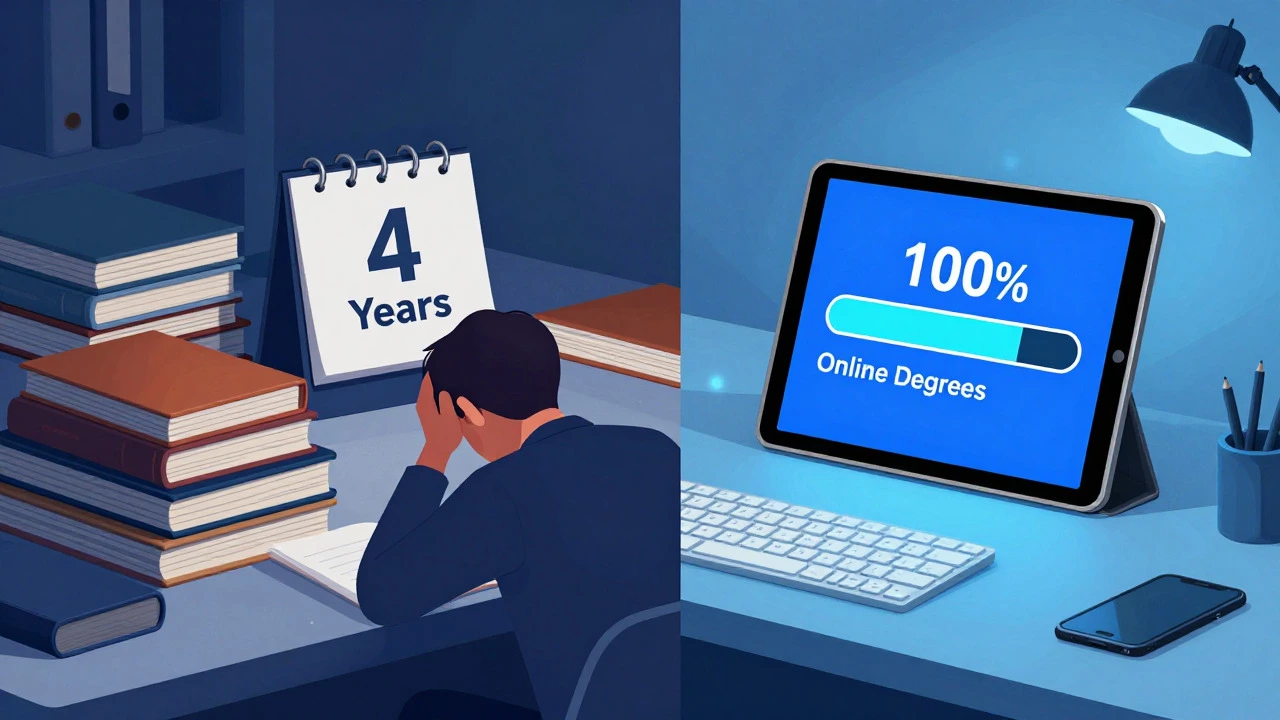
Sometimes, the question "what is the quickest degree" is really asking "what is the quickest credential that gets me hired?" In many industries, a degree is not strictly necessary. A professional certificate or bootcamp certificate can be earned in weeks or months.
For instance, a Google Data Analytics Professional Certificate takes about six months at a part-time pace. An AWS Certified Solutions Architect exam preparation might take only a few weeks of intensive study. These are not degrees, but they carry significant weight in tech, project management, and digital marketing. If your employer cares more about skill verification than academic titles, skip the degree entirely and go for the highest-level certification available in your field.
Pitfalls to Avoid When Chasing Speed
Rushing through a degree can backfire if you aren't careful. Here are common mistakes that slow people down:
- Overloading Credits: Trying to take six courses in a seven-week term while working full-time leads to burnout. Burnout causes dropped classes, which resets your progress. Pace yourself sustainably.
- Ignoring Prerequisites: Even online, some courses require foundational knowledge. Skipping ahead without understanding the basics can lead to failing grades, forcing you to retake the class.
- Choosing Unaccredited Schools: As mentioned, this renders your effort useless. Spend an extra hour researching accreditation to save years of regret.
- Underestimating Technical Requirements: Ensure your internet connection and computer can handle proctored exams and video conferencing tools. Technical glitches during a final exam can delay graduation by a whole term.
Making the Decision: Degree vs. Certification
To determine the right path for you, ask yourself three questions:
1. Does my current or target job explicitly require a degree?
2. Do I have existing credits or professional certifications that can be transferred?
3. Am I prepared to dedicate 20-30 hours per week to studying?
If the answer to #1 is yes, and #2 is also yes, aim for an accelerated Bachelor's completion program. If #1 is no, consider a high-value professional certificate. If you have no credits (#2 is no), start with an Associate Degree or a stackable certificate program that can later convert into a degree.
The quickest degree online is not a fixed product; it is a customized journey based on your existing assets. By leveraging prior learning, choosing the right accelerated format, and selecting a flexible major, you can compress years of education into a matter of months. Just remember: speed is only valuable if the credential holds weight. Prioritize accreditation and relevance over raw velocity.
Can I get a bachelor's degree online in one year?
Yes, it is possible to complete a bachelor's degree online in one year if you have significant transfer credits, prior learning assessments (PLA), or industry certifications. Without these, completing a 120-credit bachelor's degree in 12 months would require taking roughly 10 credits per month, which is extremely demanding and rare for most students.
What is the difference between an associate degree and a bachelor's degree?
An associate degree typically requires 60 credit hours and takes about two years to complete, serving as an entry-level credential or a stepping stone to a bachelor's. A bachelor's degree requires 120 credit hours, takes four years traditionally, and provides deeper specialization, often required for mid-level management roles and graduate school admission.
Are online degrees respected by employers?
Yes, provided the institution is regionally accredited. Most employers today view online degrees from reputable universities equally to on-campus degrees. The stigma against online education has largely disappeared, especially post-2020, as remote work became normalized.
What is Prior Learning Assessment (PLA)?
Prior Learning Assessment (PLA) is a process where universities grant academic credit for knowledge gained through work experience, military service, professional certifications, or independent study. This allows students to bypass certain courses, significantly reducing the time needed to earn a degree.
Which online degrees are easiest to complete quickly?
Degrees in Business Administration, Information Technology, Human Resources, and Criminal Justice are generally the easiest to complete quickly. These fields rely less on hands-on labs or clinical rotations and more on theoretical coursework, which translates well to accelerated online formats.
Do I need a degree to advance in my career?
It depends on your industry. In fields like healthcare, engineering, and academia, degrees are mandatory. In tech, creative arts, and sales, skills, portfolios, and certifications often outweigh formal degrees. Assess your specific industry requirements before committing to a lengthy degree program.