
Find Your Perfect English Learning Channel
Stop scrolling and start learning. Answer three quick questions to get a personalized recommendation from top-rated educational channels.
Your Top Match:
💡 Pro Tip for This Channel
You’ve probably spent hours scrolling through YouTube, looking for that one channel that actually makes you sound like a native speaker. Maybe you’ve tried memorizing grammar rules until your brain hurts, only to freeze up when someone asks, "How are you?" The truth is, most people don’t need more textbooks; they need the right audio input and active practice partners. And guess what? They’re already on YouTube, completely free.
But here’s the catch: not all channels are created equal. Some are great for grammar nerds but terrible for conversational flow. Others focus too much on slang and miss the basics of clear pronunciation. So, which YouTube channel is best for spoken English? It depends entirely on where you are now and where you want to be. Are you stuck at B1 intermediate level? Do you struggle with American vs. British accents? Or do you just need confidence to speak without translating in your head?
The Quick Answer: Top Picks by Goal
If you’re short on time, here’s the cheat sheet. Pick the channel that matches your specific bottleneck:
- EngVid (a network of educational video channels) is best if you need structured lessons from multiple expert teachers like Emma, Ronnie, and Adam. It’s the closest thing to a traditional classroom without the cost.
- English with Lucy (a popular British English learning channel) wins for British accent training, vocabulary expansion, and polite phrasing. If you dream of sounding like a Londoner, start here.
- Rachel’s English (an American English pronunciation-focused channel) is unmatched for mastering the American accent. Her mouth-position videos are essential if you get complimented on your grammar but criticized for your pronunciation.
- Speak English With Vanessa (a channel focusing on natural, everyday conversation) is ideal for intermediate learners who understand grammar but lack conversational fluidity. She teaches how real people talk, not how textbooks say they should.
Why "Best" Is Subjective (And How to Choose)
Before you hit subscribe, ask yourself this: What is my actual problem? Most learners mix up their goals. You might think you need better vocabulary, but your real issue is hesitation caused by over-thinking grammar. Or maybe you have perfect grammar but sound robotic because you ignore rhythm and intonation.
Think of language learning like fitness. You wouldn’t hire a bodybuilder to teach you yoga. Similarly, don’t use a grammar-heavy channel to fix your accent. Here’s a simple decision tree:
- Is your main issue understanding fast speech? Go for channels that use natural speed and provide transcripts, like English Addict with Mr Steve.
- Do you know what to say but can’t pronounce it clearly? Focus on phonetics and mouth mechanics with Rachel’s English or Pronunciation with Emma.
- Do you run out of words mid-sentence? You need idioms and collocations. Learn English with TV Series is fantastic for this because it breaks down movie scenes.
- Are you afraid of making mistakes? You need confidence-building content. Bob the Canadian offers slow, clear explanations of daily life situations, reducing anxiety.
Deep Dive: The Heavy Hitters
Let’s break down why these specific channels dominate the space. It’s not just about popularity; it’s about teaching methodology.
EngVid: The Multi-Teacher Powerhouse
EngVid isn’t just one person; it’s a collective. This is its biggest strength. If you find Emma’s teaching style too formal, switch to Ronnie, who is more casual and funny. If you need strict grammar drills, Adam is your guy. The platform allows you to filter videos by topic-IELTS, TOEFL, Business English, or General Conversation. This variety keeps things fresh. You won’t get bored listening to the same voice every day. Plus, the comments section is highly active, so you can see questions other learners asked, which often mirror your own doubts.
English with Lucy: Polishing Your British Flair
Lucy’s production quality is top-tier. But beyond the pretty visuals, her content is meticulously researched. She doesn’t just teach words; she teaches register. For example, she’ll explain the difference between saying "I’m going to" and "I shall," and when using either sounds weird in modern Britain. Her "Common Mistakes" series is gold for advanced learners who want to eliminate subtle errors that betray them as non-natives. If you’re preparing for IELTS or working in international business in Europe, this channel is a strategic asset.
Rachel’s English: The Science of Sound
Most channels tell you to "sound American." Rachel shows you exactly how. She uses diagrams of the tongue position, lip shape, and airflow. This is crucial because many non-native speakers try to mimic the sound without adjusting their physical articulation. Her "American Pronunciation Guide" playlist is essentially a free course in phonetics. She also covers cultural nuances, explaining why Americans swallow certain sounds or link words together (connected speech). If you watch movies without subtitles and still feel lost, it’s likely because you aren’t hearing the linked sounds Rachel teaches.
Speak English With Vanessa: Conversational Flow
Vanessa targets the "intermediate plateau"-that frustrating stage where you can read well but speak poorly. Her videos often simulate real conversations. She’ll act out a scenario, like ordering coffee or chatting with a colleague, then pause to explain the phrases used. The key takeaway here is naturalness. She teaches contractions (gonna, wanna, gotta) and filler words (um, well, actually) that make you sound human rather than like a robot reciting a script. Her approach reduces the mental load of translation because she focuses on chunks of language rather than individual words.

Comparison Table: Finding Your Match
| Channel Name | Primary Accent | Best For | Teaching Style | Level |
|---|---|---|---|---|
| EngVid | Mixed (US/UK/Aus) | Grammar & Exam Prep | Structured Lessons | Beginner to Advanced |
| English with Lucy | British (RP) | Vocab & Politeness | Elegant & Detailed | Intermediate to Advanced |
| Rachel’s English | American (General) | Pronunciation & Listening | Scientific & Visual | All Levels |
| Speak English With Vanessa | American (Casual) | Conversational Fluency | Natural & Friendly | Intermediate |
| Learn English with TV Series | Mixed | Slang & Pop Culture | Entertainment-Based | Upper Intermediate+ |
How to Actually Learn (Not Just Watch)
Here is the hard truth: Watching YouTube is passive. Speaking English is active. If you just binge-watch videos while eating dinner, your speaking skills won’t improve much. You need a system. Here is a 3-step routine that works:
Step 1: Shadowing Technique
Pick a 30-second clip from Rachel’s English or Vanessa. Listen to it once. Then, play it again and speak along with the host, trying to match their speed, tone, and pauses exactly. Don’t worry about meaning yet; focus on the music of the sentence. Do this five times. Your mouth muscles will start to remember the movements.
Step 2: Active Note-Taking
Don’t write down single words. Write down "chunks." Instead of writing "decision," write "make a difficult decision." Instead of "meeting," write "schedule a meeting." English with Lucy is great for this because she highlights collocations. These chunks help you speak faster because your brain retrieves pre-made phrases instead of building sentences word-by-word.
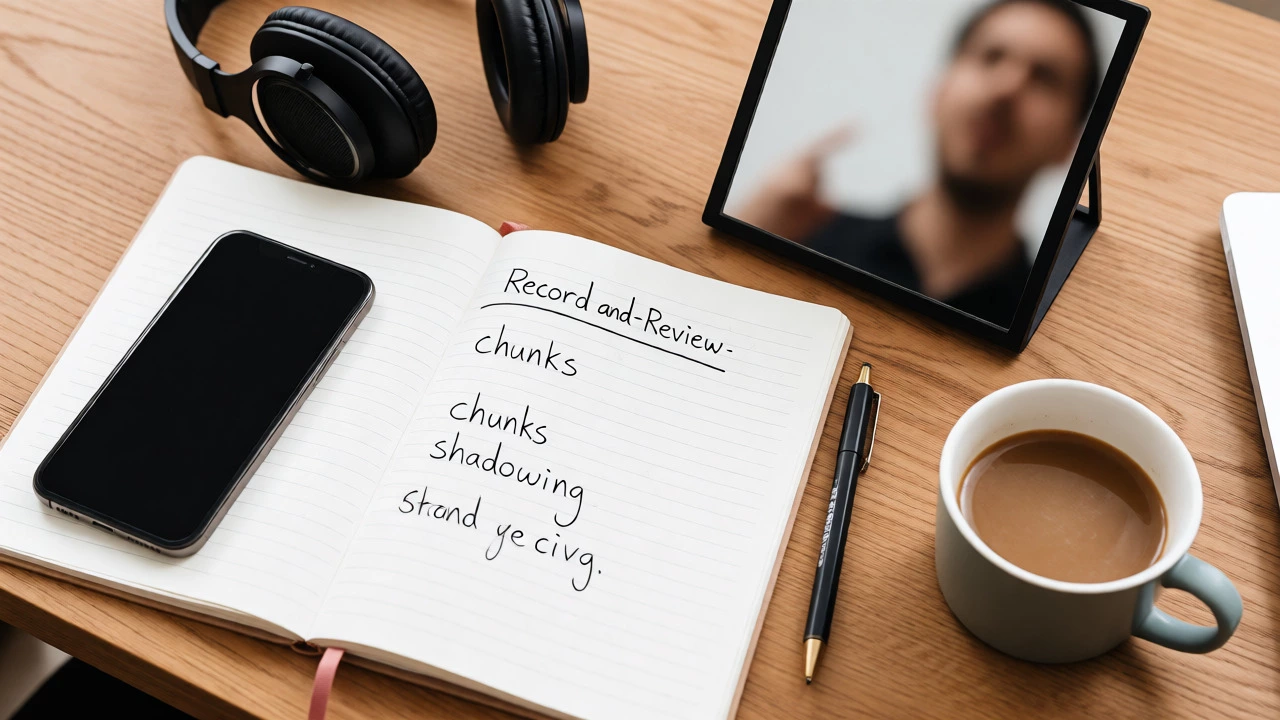
Step 3: The Record-and-Review Loop
This is painful but necessary. After watching a lesson, record yourself answering the question posed in the video. Use your phone. Listen to your recording. Compare it to the teacher’s audio. Where did you hesitate? Which vowel sound was off? This feedback loop closes the gap between knowing and doing.
Beyond the Big Names: Hidden Gems
Once you’ve exhausted the major players, look into niche channels that offer specific value:
- mmmEnglish (an Australian English learning channel) is excellent if you need to deal with Australian accents or prefer a very encouraging, supportive teaching style. Emma (the host) is incredibly patient.
- Lingoni (a channel focused on practical, situational English) is great for business contexts. They role-play interviews, negotiations, and office small talk, which is rare in general ESL channels.
- ETJ English (a channel dedicated to British pronunciation coaching) is a favorite among actors and serious accent learners. It’s less about grammar and more about the physical mechanics of British RP.
Pitfalls to Avoid
Don’t fall into the "Collector’s Trap." Subscribing to 50 channels feels productive, but it leads to analysis paralysis. Stick to two: one for input (listening/pronunciation) and one for output (vocabulary/conversation). Also, beware of channels that promise "Fluent in 7 Days." Language acquisition is biological; it takes time. If a video claims you can master complex tenses in 5 minutes, it’s oversimplifying. Real progress comes from consistent, boring repetition, not magic tricks.
Finally, stop worrying about perfection. Native speakers make mistakes too. They use wrong verb tenses, mumble, and use slang incorrectly. Your goal isn’t to be a textbook; it’s to be understood and connected. A channel that makes you laugh or feel relaxed is often better than a "perfect" one that stresses you out.
Which YouTube channel is best for absolute beginners?
For absolute beginners, EngVid (specifically teachers like JamesESL or Ronnie) is recommended because they break down basic structures slowly. Additionally, Bob the Canadian is excellent because he speaks slowly, points to objects, and uses simple vocabulary related to daily life, which helps build foundational comprehension without overwhelming you.
Can I learn a specific accent from YouTube alone?
Yes, especially for American or British accents. Rachel’s English provides detailed visual guides for American pronunciation, while ETJ English or English with Lucy cover British nuances. However, you must practice actively using shadowing techniques. Passive watching will improve your ear, but not necessarily your tongue's muscle memory.
Are paid courses better than free YouTube channels?
Paid courses offer structure, accountability, and personalized feedback, which YouTube lacks. YouTube is fantastic for input and exposure, but it cannot correct your specific mistakes. A hybrid approach is best: use YouTube for daily immersion and vocabulary, and consider a tutor or paid app for speaking practice and correction.
How many YouTube channels should I follow?
Limit yourself to 2-3 channels maximum. One for your primary accent/pronunciation (e.g., Rachel’s English), one for general vocabulary/grammar (e.g., EngVid), and optionally one for entertainment/casual listening (e.g., Learn English with TV Series). Too many sources cause confusion and dilute your study time.
What if I find a teacher’s personality annoying?
Switch immediately. Consistency is key to language learning, and you won’t stay consistent if you dislike the instructor. There are dozens of high-quality alternatives. For example, if you dislike Lucy’s formality, try Speak English With Vanessa for a more casual vibe. Your comfort level directly impacts retention.