
Salary Estimator Tool
Find Your Potential Salary
Estimate your earnings based on the career paths discussed in the article.
Your Estimated Salary Range
Based on article data: New Zealand ($65k-$85k), US ($75k-$100k)
Want a high salary without spending years in school? You’re not alone. More people are skipping traditional degrees and going straight for courses that pay off fast. The truth? There’s no magic bullet, but some courses are easier to finish and still land you $80,000+ a year-even if you’ve never coded before.
Web Development is the quiet winner
Frontend web development is the easiest high-paying course you can take right now. Why? Because you don’t need a computer science degree. You don’t need to memorize algorithms. You just need to learn HTML, CSS, and JavaScript-and build real websites.
Most people finish a solid frontend course in 3 to 6 months. Full-time learners do it in 12 weeks. Part-timers with a job? 20 hours a week gets you there in 6 months. Platforms like freeCodeCamp, Codecademy, and Udemy have courses that walk you through building your first portfolio site in under 10 hours.
Here’s what you actually learn:
- HTML: Structure a webpage (like putting together a document)
- CSS: Make it look good (colors, layouts, buttons)
- JavaScript: Make it work (buttons that click, forms that send data)
- React: The most popular tool companies use to build modern sites
After that, you build 3-5 projects. A personal portfolio. A weather app. A task manager. That’s it. No thesis. No exams. Just code you can show employers.
In New Zealand, junior frontend developers earn between $65,000 and $85,000. In the US, it’s $75,000-$100,000. Remote jobs pay even more. Companies don’t care if you went to university. They care if your code works.
Why not data science or AI?
You’ve probably heard people say, “Learn Python and get rich.” But data science isn’t easy. It needs math, statistics, machine learning, and domain knowledge. Most people who start it quit after 3 months because it’s overwhelming.
Web development? You can start making money while you’re still learning. You can freelance on Upwork for $25/hour after your third project. You don’t need to wait for a job offer. You can get paid as you go.
Other easy, high-paying options
Frontend dev isn’t the only path. Here are three others that are simpler than they sound:
- Technical Writing - If you can write clearly, you can explain software to users. Companies pay $70,000-$95,000 for writers who can turn jargon into plain English. You don’t need to code-just learn how software works.
- Cybersecurity Fundamentals - Certifications like CompTIA Security+ take 3-4 months to pass. Entry-level roles pay $70,000+ in NZ and $80,000+ in the US. You learn how to spot hackers, not build them.
- UX/UI Design - Designing apps and websites. Tools like Figma are free. You learn user flow, wireframes, and color psychology. Most courses are 4-6 months. Salaries start at $75,000.
All of these skip the traditional 3-4 year degree path. No student loans. No general education classes. Just skills that employers actually need.

What you shouldn’t waste time on
Not every “easy” course pays well. Avoid these traps:
- Graphic Design (general) - Too many freelancers. Pay is low unless you specialize in branding for big companies.
- Digital Marketing (general) - Everyone claims to be an expert. Without analytics or paid ads skills, you’re just another person with a Facebook ad certificate.
- Blockchain Development - Too volatile. Few companies hire juniors. You need deep math and crypto knowledge.
These fields have low barriers to entry-but also low pay. You’ll be competing with thousands of others who took the same 10-hour course.
How to pick the right course for you
Here’s a simple filter:
- Can you finish it in under 6 months?
- Does it require a degree? (If yes, skip it.)
- Can you build something real in the first 2 weeks?
- Are companies hiring juniors in this field right now?
If you answered yes to all four, it’s worth trying.
Try this: Spend one weekend doing a free intro to web development. If you enjoy fixing a broken button or making a button change color when clicked, you’re already on the right path.
Real stories from real people
In Auckland, a 34-year-old retail worker took a 16-week online frontend course. She built a site for her cousin’s bakery. Then she made one for a local yoga studio. Within 8 months, she got hired as a junior developer at a small tech firm. Her salary: $78,000.
A former teacher in Wellington switched to technical writing after learning how to document software. He now works remotely for a US company. He earns $92,000 NZD and works 4 days a week.
These aren’t outliers. They’re people who picked a path that’s actually doable.
What you need to succeed
You don’t need talent. You need consistency.
Here’s the routine that works:
- Study 1 hour a day, 5 days a week
- Build one small project every 2 weeks
- Post your work on GitHub
- Apply to 5 junior jobs every week after 3 months
Most people fail because they wait until they’re “ready.” You’re never ready. You get hired because you showed up with something built.
Where to start today
Here are three free, trusted places to begin:
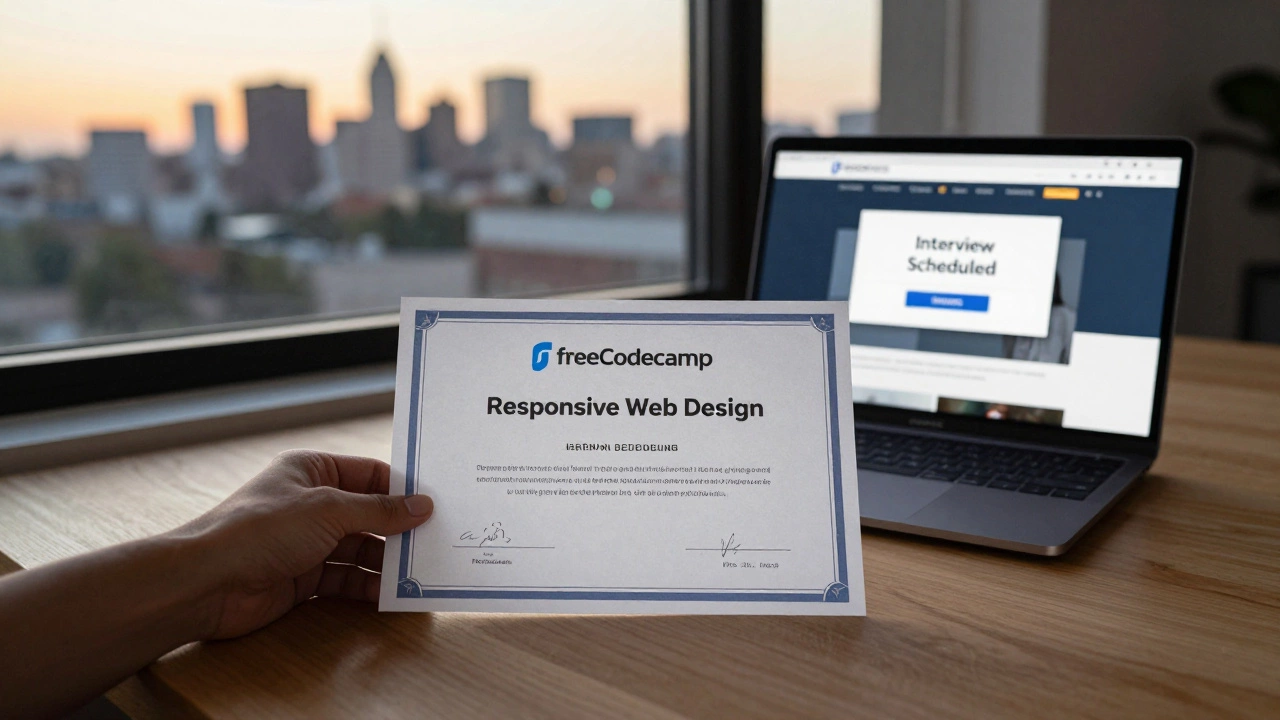
- freeCodeCamp - Complete the Responsive Web Design and JavaScript Algorithms certifications. Takes 200-300 hours. Free.
- Codecademy - Try their “Front-End Developer Career Path.” $15/month. Includes projects.
- YouTube - Search “HTML CSS JavaScript project tutorial.” Follow along. Build. Repeat.
Don’t buy a $1,000 course. Start with free. See if you like it. Then invest.
Final thought
The easiest course with a high salary isn’t about being the smartest. It’s about being the one who finishes.
There are thousands of people who know how to code. But only the ones who actually build things and send out applications get hired.
You don’t need a degree. You don’t need to be 22. You just need to start today.
Can I really get a high salary without a degree?
Yes. Many tech companies, especially startups and remote firms, hire based on skills, not degrees. Frontend developers, technical writers, and junior cybersecurity analysts often start at $70,000+ with just a certificate and a portfolio. In New Zealand and the US, employers care more about what you can build than where you went to school.
How long does it take to learn web development?
You can learn the basics of HTML, CSS, and JavaScript in 4-8 weeks with 10-15 hours per week. To get job-ready-meaning you can build real websites and explain your code-you’ll need 3-6 months of consistent practice. Most people land their first job after 4-5 projects.
Is web development still in demand in 2026?
Absolutely. Every business needs a website, app, or digital presence. Even government agencies and hospitals are hiring frontend developers. The demand for skilled developers is growing faster than the supply. In New Zealand, over 2,000 tech roles went unfilled in 2025. Junior roles are especially open to self-taught candidates.
Do I need to be good at math?
No. Web development doesn’t require advanced math. You’ll use basic arithmetic for layout spacing and percentages, but nothing beyond high school level. If you can count change or calculate a tip, you can handle the math in web dev. This is a common myth that keeps people from trying.
What’s the difference between frontend and backend development?
Frontend is what users see and interact with-buttons, menus, forms. Backend is what happens behind the scenes-servers, databases, login systems. Frontend is easier to start with because you get instant visual feedback. Backend requires understanding servers and databases, which adds complexity. Most beginners start with frontend and move to backend later.
Can I do this while working full-time?
Yes. Most people who switch careers do it while working. 15-20 hours a week is enough. That’s about 2-3 hours a night and a few hours on weekends. It takes longer-maybe 6-9 months-but it’s doable. The key is consistency, not intensity.
What if I don’t like coding?
Then try technical writing or UX/UI design. Both are high-paying, low-barrier fields that don’t require writing code. Technical writers explain how software works. UX designers focus on user experience using tools like Figma. Both pay $70,000-$95,000 and are in high demand. Pick the one that feels more like writing or drawing than typing commands.