E-Learning Platform Selector
Answer three quick questions to find the right platform for your current learning goal.
You’re scrolling through your phone at 10 PM, trying to figure out how to pivot your career or just learn a new skill without going back to university. You type "best online courses" into the search bar and get hit with a wall of noise. Thousands of sites. Hundreds of certifications. Which ones actually matter? It’s overwhelming, right?
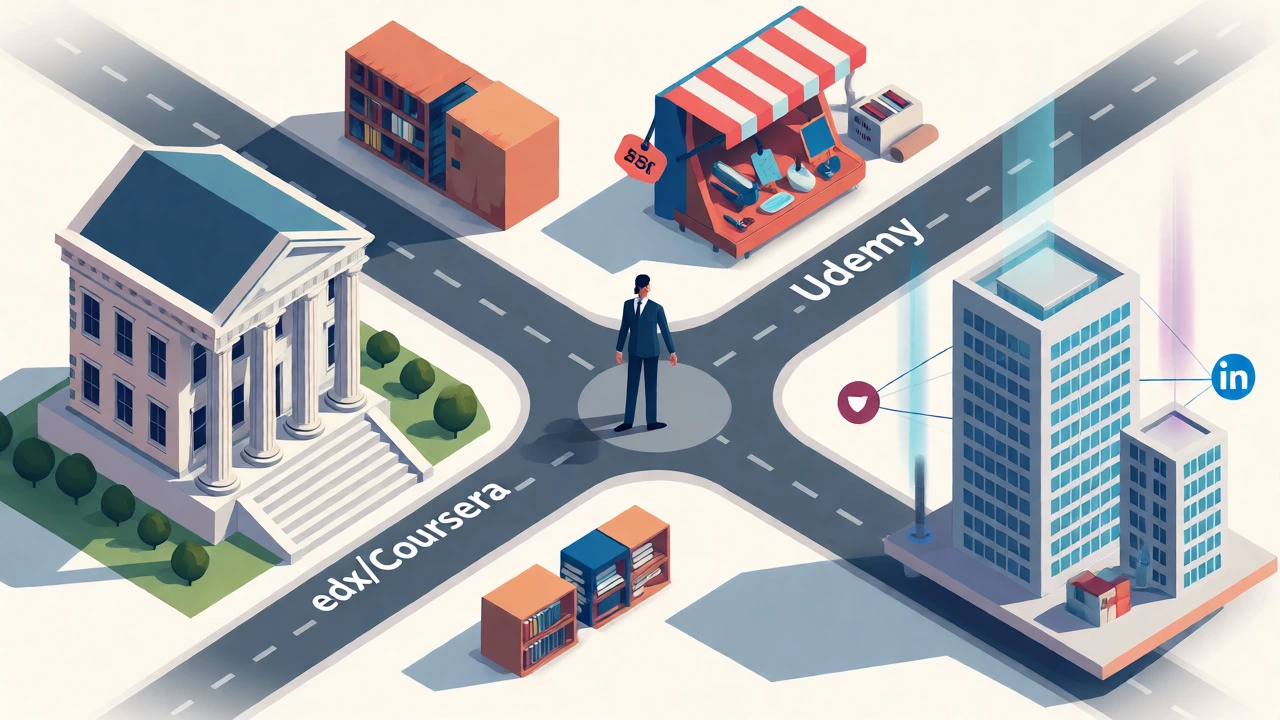
Here’s the thing: you don’t need to know every platform in existence. You really only need to understand four major players that dominate the landscape in 2026. These aren't just random websites; they represent different models of education. One is about prestige, one is about practical skills, one is about corporate upskilling, and one is about massive open access. If you can distinguish between Coursera, Udemy, a marketplace for online video courses where instructors set their own prices and content quality varies widely, edX, a non-profit MOOC provider founded by Harvard and MIT focusing on academic rigor, and LinkedIn Learning, a subscription-based service integrated with professional networking profiles, you’ve got 90% of your decision-making done.
The Prestige Play: Why Choose Coursera?
If you care about what’s written on your CV more than anything else, start here. Coursera partners directly with universities like Stanford, Yale, and the University of Michigan. When you finish a course, you get a certificate signed by them. That carries weight.
But it’s not just about the logo. The structure is rigorous. You’ll have weekly deadlines, peer-graded assignments, and quizzes that actually require you to read the material. I took a data science specialization last year, and I couldn’t just watch videos passively. I had to submit code and write reports. If you’re lazy, you’ll fail. If you’re disciplined, you’ll gain a credential that hiring managers recognize globally.
Is it expensive? Yes. Individual courses often run $49-$79 per month if you want the graded work and certificate. But many offer financial aid, which is a hidden gem most people ignore. Apply for it. Seriously. The approval rate is surprisingly high if you explain your situation honestly.
The Skill Marketplace: Navigating Udemy
Now, flip the script. What if you don’t care about a university stamp? What if you just want to learn Python in three days because you have a project due Friday? Enter Udemy.
Udemy operates differently from Coursera. It’s an open marketplace. Anyone can teach. This means quality control is... let’s say, inconsistent. You might find a masterpiece of a course for $15 during a sale, or you might find a rambling mess recorded on a bad webcam. How do you avoid the junk? Check the reviews. Look for courses with over 10,000 students and a rating above 4.5. Read the recent negative reviews specifically-they tell you if the content is outdated.
The beauty of Udemy is lifetime access. Buy it once, watch it forever. Updates are usually free. For coding bootcamps, graphic design tools, or Excel hacks, this is often the best bang for your buck. Just remember: you won’t get a university credit. You’re buying knowledge, not status.
The Academic Heavyweight: Understanding edX
Think of edX as Coursera’s older, stricter sibling. Founded by Harvard and MIT, it leans heavily into the Massive Open Online Course (MOOC) model. While Coursera has pivoted slightly toward professional certificates, edX keeps its roots in traditional academia.
The interface feels more like a university portal. You audit courses for free-meaning you see the videos and readings but don’t get graded or certified. Want the verified certificate? That costs money, often ranging from $50 to $300 depending on the institution. Some programs even offer MicroMasters credentials, which are essentially graduate-level chunks of a degree. If you’re eyeing a master’s program later, these credits can sometimes transfer.
Who is this for? Students who want deep theoretical understanding. If you’re studying economics, computer science fundamentals, or history, edX offers depth that marketplaces rarely match. The community forums are also populated by serious learners, not just casual hobbyists.

The Career Connector: Leveraging LinkedIn Learning
Here’s where things get practical for working professionals. LinkedIn Learning isn’t about getting a degree. It’s about closing the gap between your current job and your next promotion. Because it’s owned by LinkedIn, your completed courses automatically appear on your profile. Recruiters see this. It signals continuous improvement.
The content is short, punchy, and focused on soft skills and business tools. Need to learn negotiation tactics? There’s a two-hour course on it. Struggling with PowerPoint animations? Done in 45 minutes. Instructors are often industry practitioners, not academics. They speak the language of the boardroom, not the lecture hall.
Pricing is a flat monthly subscription, usually around $30/month, or included if you have a Premium LinkedIn account. If you already pay for LinkedIn Premium, you’re effectively getting thousands of dollars worth of training for free. Use those credits. Don’t let them sit idle.
Comparing the Big Four: Which Fits Your Goal?
Choosing the wrong platform wastes time and money. Let’s break down the attributes side-by-side so you can make a quick call.
| Feature | Coursera | Udemy | edX | LinkedIn Learning |
|---|---|---|---|---|
| Primary Focus | University-backed specializations & degrees | Practical, niche skills & hobbies | Academic rigor & verified certificates | Professional development & soft skills |
| Cost Model | Subscription ($49+/mo) or per-course | Pay-per-course (often $10-$20 on sale) | Audit free / Verified Cert ($50-$300) | Subscription (~$30/mo) or bundled |
| Certificate Value | High (recognized by employers) | Low (proof of completion only) | High (academic recognition) | Medium (visible on LinkedIn profile) |
| Best For | Career changers needing credentials | Quick fixes & specific tool mastery | Deep theoretical learners | Corporate employees & networkers |
Common Pitfalls and Pro Tips
People quit these platforms faster than they quit the gym. Why? Because they treat them like Netflix. You binge-watch a course for three nights, feel smart, then forget everything by week four.
Here is how to stick with it:
- Set a schedule, not a goal. Don’t say "I will learn Java." Say "I will spend 30 minutes on Tuesday and Thursday evenings." Consistency beats intensity.
- Apply immediately. Learned a new function in Excel? Use it in your actual work spreadsheet the next day. If you don’t use it, you lose it.
- Mix and match. You don’t have to pick one. Take a theory-heavy course on edX for background, then buy a practical Udemy course to learn the software implementation. They complement each other.
- Check the date. On Udemy especially, ensure the course was updated within the last 12 months. Tech changes fast. A Python course from 2020 might miss critical library updates.
Final Thoughts on Choosing Your Path
There is no "best" platform. There is only the best platform for your specific problem. If you need a credential to get past HR filters, go Coursera or edX. If you need to fix a bug in your website today, go Udemy. If you want to look proactive in your annual review, grind through some LinkedIn Learning modules.
Stop analyzing. Pick one. Sign up. Start tonight. The perfect course doesn’t exist, but the first step does.
Are Coursera certificates worth the money?
Yes, if you are looking for career advancement or a career change. Employers recognize university partnerships. However, if you only want personal enrichment, auditing for free is sufficient.
Can I get college credit from edX?
Sometimes. Many universities accept verified certificates from edX for credit, but policies vary strictly by institution. Always check with your registrar before paying for a verified track.
Is Udemy good for coding beginners?
It can be, but you must choose carefully. Look for highly-rated instructors with large student bases. Supplement with official documentation, as some Udemy courses may lag behind the latest language versions.
Do recruiters look at LinkedIn Learning completions?
Not necessarily as a primary qualification, but it adds context to your profile. It shows initiative and relevant skill keywords that help you appear in recruiter searches.
Which platform is cheapest for long-term learning?
Udemy is cheapest for single topics due to sales. Coursera Plus or edX subscriptions can be cost-effective if you plan to take multiple specialized courses in a short period.