
🎯 Find Your Ideal English Speaking App
Before downloading an app, you need to know exactly what's holding you back. Answer these two questions to find your perfect match.
Step 1: Identify Your Main Bottleneck
Sounds & Accent
You understand grammar but struggle with specific sounds like 'th', 'r', or 'l'. People ask you to repeat yourself.
Confidence & Anxiety
You freeze up mid-sentence. Fear of making mistakes or being judged shuts down your output during conversations.
Vocabulary & Exposure
You lack the words for complex ideas or simply don't hear natural rhythm/intonation because you study alone.
Step 2: What is your primary goal?
Recommended Strategy
App NameWhy this works for you
App Name
Cost ModelStanding in a room full of people who speak English fluently while you freeze up because your brain can't find the right words? It happens. You know the grammar rules. You understand what they're saying. But when it's your turn to talk, silence wins. The gap between knowing English and speaking it is real, and most traditional courses fail to bridge it.
You don't need another textbook. You need a tool that forces you to open your mouth, listen to yourself, and correct mistakes in real-time. In 2026, technology has made this possible without needing a tutor sitting next to you. But with dozens of apps claiming to fix your accent or boost your confidence, how do you pick the one that actually works for your specific situation?
Quick Summary / Key Takeaways
- ELSA Speak is best for fixing pronunciation and accent clarity using AI feedback.
- Tandem offers free conversation practice with native speakers but requires consistent effort to maintain matches.
- Cambly provides on-demand video calls with tutors, ideal for those who need human interaction to overcome anxiety.
- For business professionals, LingQ helps build vocabulary through context rather than rote memorization.
- The "best" app depends on whether you struggle with sounds (pronunciation), fear of judgment (confidence), or lack of partners (exposure).
Understanding Your Specific Speaking Bottleneck
Before downloading anything, identify why your speaking feels stuck. Most learners fall into one of three categories. If you sound like you have a mouthful of marbles, your issue is phonetic. You might be mispronouncing specific sounds like 'th' or 'r', making you hard to understand even if your grammar is perfect. If you freeze up mid-sentence, your issue is psychological. You know the words, but the fear of making a mistake shuts down your output. If you simply never get the chance to talk, your issue is exposure. You study alone and never hear natural rhythm or intonation.
Different apps solve different problems. Using an AI pronunciation trainer when you just need a conversation partner is like taking a math course to learn how to drive. Match the tool to the pain point.
Top Contenders for Pronunciation and Accent Correction
If your main goal is to be understood clearly, ELSA Speak is the industry standard. It uses Artificial Intelligence speech recognition that analyzes individual phonemes. When you record a sentence, it doesn't just tell you if you were wrong; it highlights exactly which syllable was off-pitch or misshaped. This granular feedback is crucial for non-native speakers whose first languages lack certain English sounds. For example, Japanese speakers often struggle with 'l' and 'r' distinctions, and ELSA breaks these down visually and audibly.
Another strong option here is Pronunciation Pro, which focuses heavily on minimal pairs-words that differ by only one sound, like 'ship' and 'sheep'. Mastering these prevents misunderstandings in critical situations. Unlike broader language apps, these specialized tools drill down into the mechanics of speech production, helping you retrain your muscle memory over time.

Building Confidence Through Human Interaction
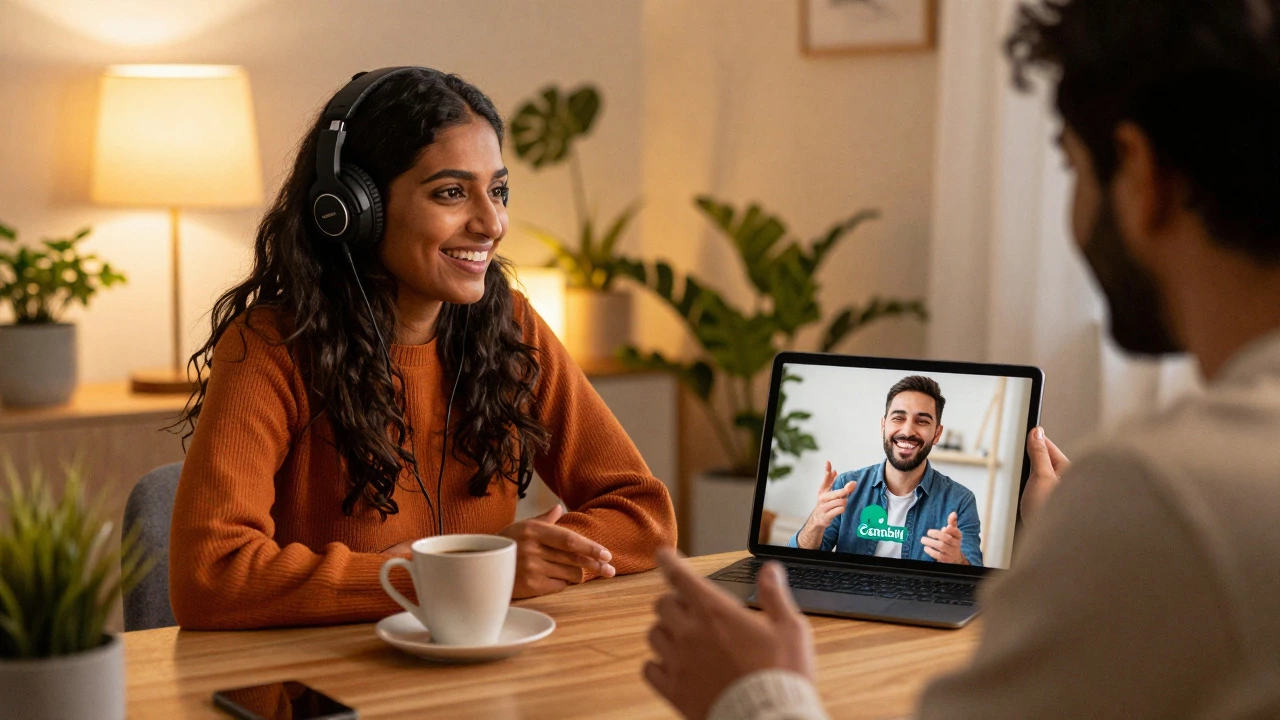
AI is great for correction, but humans are essential for connection. If social anxiety holds you back, Cambly removes the pressure of scheduling. You book a 15-minute slot, and a native speaker joins via video. There’s no curriculum; you just chat. This low-stakes environment helps desensitize the fear of being judged. Many users report that after just two weeks of daily 15-minute sessions, their hesitation drops significantly because the interaction feels less like an exam and more like a coffee chat.
On the other end of the spectrum is HelloTalk, a community-based platform where you connect with peers from around the world. It’s less structured than Cambly but offers more variety. You can text, voice-note, or call. The catch? You have to keep the conversation going. If you’re passive, you’ll burn out quickly. But if you’re proactive, it’s an endless source of diverse accents and cultural contexts that textbooks rarely capture.
Vocabulary and Contextual Fluency
Sometimes, you don’t lack speaking skills; you lack the words to express complex ideas. LingQ takes a different approach. Instead of isolated drills, it immerses you in content-podcasts, articles, videos-that you can click to translate and save. By hearing words used in natural flow, you learn collocations (words that naturally go together) rather than just definitions. This contextual learning translates directly to better spontaneous speech because you’re retrieving phrases, not constructing sentences word-by-word from scratch.
| App Name | Primary Focus | Cost Model | Best For |
|---|---|---|---|
| ELSA Speak | Pronunciation & Accent | Freemium / Subscription | Fixing specific sound errors |
| Cambly | Live Tutor Conversation | Subscription | Overcoming speaking anxiety |
| Tandem | Peer Exchange | Free / Premium | Cultural exchange & casual chat |
| LingQ | Vocabulary via Content | Subscription | Business & academic fluency |
Choosing the Right Strategy for Your Goal
There is no single "best" app because there is no single type of learner. If you are preparing for an interview in New York or London, prioritize Cambly or similar live-tutor platforms to simulate high-pressure scenarios. If you are traveling and want to order food confidently, ELSA Speak will give you the clearest delivery fastest. If you are a student aiming for academic writing and discussion, LingQ builds the necessary depth of vocabulary.
Consider combining tools. A common effective routine involves 10 minutes of pronunciation drills in the morning, 15 minutes of listening to native content during your commute, and one 20-minute conversation session in the evening. This multi-modal approach ensures you are training both your ear and your mouth simultaneously.
Common Pitfalls to Avoid
Don't rely solely on text-based apps. Reading and writing are passive skills. Speaking is active. If your app doesn't make you press a microphone button at least once a day, it won't improve your speaking. Also, avoid perfectionism. Native speakers make grammatical errors all the time. The goal is communication, not error-free recitation. Finally, consistency beats intensity. Ten minutes every day is far more effective than two hours once a week. Language acquisition is a habit, not an event.
Frequently Asked Questions
Can I really improve my accent with an app?
Yes, especially for adult learners who may have fossilized certain sounds. Apps like ELSA Speak provide visual feedback on mouth position and pitch, which is something a friend or colleague rarely offers. However, complete elimination of an accent is difficult; the realistic goal is intelligibility and reduced foreignness.
Which app is best for absolute beginners?
Beginners should start with structured platforms that offer basic vocabulary and simple sentence structures. While ELSA is good for pronunciation, it assumes you already know some words. Apps that combine audio input with basic lesson plans are better starting points before moving to pure conversation tools.
Are free apps enough to become fluent?
Free versions of apps like Tandem or HelloTalk are powerful for maintaining fluency and finding partners, but they lack the structured progression of paid tiers. Paid subscriptions usually unlock detailed analytics, unlimited access to tutors, or advanced AI features that accelerate progress significantly.
How long does it take to see results?
Most users notice improved confidence within 4-6 weeks of daily practice. Pronunciation improvements can be seen in as little as 2 weeks with focused drilling. Full conversational fluency typically takes 6 months to a year of consistent daily use, depending on your starting level.
Do I need internet connectivity for these apps?
Most modern apps require an internet connection for AI processing and live conversations. However, many allow you to download lessons for offline review. For pronunciation drills, some apps process audio locally, but syncing progress and accessing new content usually requires data.