
Online College Matchmaker
Stop guessing which online college is "best." Use this tool to identify the top contender for your specific situation by answering three simple questions.
Recommended Top Contender
Cost Estimate
| University | Estimated Total Tuition* | Key Advantage |
|---|
You are sitting at your kitchen table, coffee getting cold, staring at a list of fifty universities that all claim to be "the best" for remote learning. It’s exhausting, right? You want the truth, not marketing fluff. So, what is the #1 online college in the US? The honest answer is that there isn't one single winner for everyone. But if you look at the data that actually matters-graduation rates, student satisfaction, and employer recognition-one name consistently rises to the top: Arizona State University (ASU).
Why ASU? Because it doesn’t just offer online courses; it has built an entire ecosystem designed for digital students. But before you pack your bags (or rather, before you click "apply"), you need to understand why ranking lists change depending on who you ask. Is it about prestige? Cost? Support services? This guide breaks down exactly how to find the right fit for you, using real metrics instead of vague promises.
The Short Answer: Why ASU Takes the Crown
Arizona State University is a public research university known for its massive scale and innovative approach to online education. In recent rankings by U.S. News & World Report and other major educational bodies, ASU frequently holds the top spot for "Most Innovative Schools" and often leads in undergraduate online program quality.
Here is why this matters to you. Most traditional universities bolted online programs onto their existing structures. They treated online students like second-class citizens with fewer resources. ASU flipped the script. They invested heavily in technology and support specifically for remote learners. When you enroll, you aren't just watching recorded lectures. You get access to dedicated career coaches, tech support that actually answers the phone, and a community that feels tangible despite being digital.
Is it perfect? No. Large institutions can feel impersonal. But for sheer reliability and breadth of options, it is hard to beat. If you want a degree that carries weight without the hassle of navigating a bureaucratic nightmare, ASU is the safest bet for most people.
Defining "Best": What Actually Counts?
Before you trust any "Top 10" list, you need to know what they are measuring. A ranking based solely on endowment size means nothing to a working parent trying to finish a degree while raising kids. Here are the four pillars that should drive your decision:
- Accreditation: This is non-negotiable. Look for regional accreditation (like WSCUC or HLC). Without it, your credits might not transfer, and employers might ignore your degree.
- Graduation Rates: High enrollment doesn't mean success. Look for schools where at least 60-70% of online students actually finish. Low completion rates signal poor support systems.
- Cost Transparency: Does the school charge more for out-of-state online students? The best schools charge a flat rate regardless of where you live. Hidden fees kill budgets.
- Employer Recognition: Will companies respect the diploma? Check if the degree says "Online" or just the university name. Most reputable schools now omit the word "online," which is a good sign.
If a school fails on accreditation, walk away immediately. Everything else is secondary.
Top Contenders Beyond ASU
While ASU leads in innovation, other schools dominate specific niches. Your "#1" might depend on your major or budget. Let's look at the heavy hitters.
| University | Best For | Approx. Tuition (In-State) | Key Strength |
|---|---|---|---|
| Arizona State University | Innovation & Scale | $580/credit | Massive resource library & career support |
| Pennsylvania State University | Traditional Prestige | $430/credit | Huge alumni network & brand recognition |
| Western Governors University | Working Professionals | $3,900/term (flat) | Competency-based (finish faster) |
| University of Florida | Affordability | $128/credit (out-of-state) | Low cost for high-quality state school |
Penn State World Campus is the go-to if you care about legacy. Their brand is recognized globally, especially in corporate America. If you are aiming for management roles, the Penn State name opens doors.
Western Governors University (WGU) is a disruptor. It uses a competency-based model. Instead of paying per credit hour, you pay per six-month term. If you have prior experience, you can test out of classes and graduate in two terms instead of eight. It’s risky if you procrastinate, but incredibly efficient if you are disciplined.
University of Florida wins on price. They charge out-of-state students nearly the same as in-state residents. For a bachelor's degree, this could save you $20,000 compared to private alternatives.

How to Choose Based on Your Goals
Stop looking at rankings and start looking at your life. Which scenario fits you best?
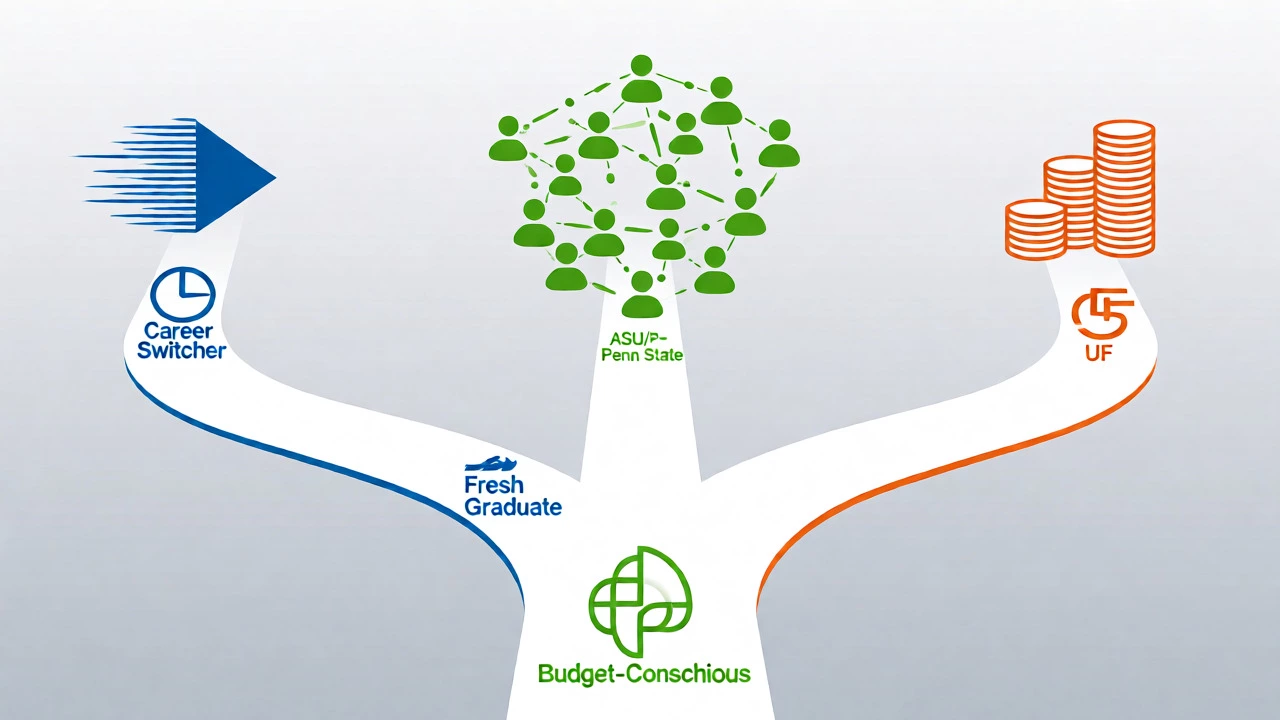
Scenario A: The Career Switcher
You already have a job and need a credential to move up. You don't have time for slow-paced lectures. You need speed and flexibility. Look at competency-based schools like WGU or Southern New Hampshire University (SNHU). These programs let you accelerate through material you already know. Focus on schools with strong industry partnerships for networking.
Scenario B: The Fresh Graduate
You are young, maybe working part-time, and want the full university experience. You need structure, social interaction, and rigorous academics. Traditional large state schools like ASU or Penn State are better here. They offer clubs, virtual study groups, and a structured semester pace that keeps you accountable.
Scenario C: The Budget-Conscious Learner
You cannot afford debt. You need the lowest possible tuition. Public universities with flat-rate online pricing are your friends. Check the University of Florida, Oregon State University, or Georgia Tech. Always calculate the total cost including books and fees, not just the sticker price.
Pitfalls That Trap Online Students
Thousands of students drop out of online programs every year. It’s rarely because the work was too hard. It’s usually because of these three traps:
- The "Set and Forget" Mentality: Online courses require more self-discipline than in-person ones. There is no professor tapping your shoulder. If you fall behind in week two, you will likely fail by week five. Treat it like a job. Block out fixed hours for study.
- Ignoring Technical Requirements: Some programs require specific software or hardware. Don't assume your old laptop works. Check the technical specs early. Internet connectivity issues are the number one excuse for missed deadlines.
- Underestimating Networking: Many online students isolate themselves. They attend no events, email no professors, and join no groups. This leaves them with a degree but no connections. Force yourself to participate in discussion boards and virtual office hours.
Verifying Accreditation and Quality
You found a school. Great. Now verify it. Do not rely on the school's website alone. Go to the Database of Accredited Postsecondary Institutions and Programs run by the US Department of Education. Search for the school's name. Ensure the accreditation is "Regional," not just "National." Regional accreditation is held by traditional universities and is respected everywhere. National accreditation is common in vocational schools and may limit credit transfers.
Also, check the graduation rates on the National Center for Education Statistics (NCES) website. Compare the online graduation rate to the campus one. If the online rate is significantly lower (e.g., 20% vs 60%), something is wrong with the online support structure.
Next Steps for Your Application
Ready to act? Here is your checklist:
- Narrow your list to 3 schools based on your major and budget.
- Contact admissions advisors at each. Ask specific questions: "What is the average response time from instructors?" and "Are there live sessions required?"
- Request a sample syllabus. Read it. Does it look engaging or dry?
- Apply for FAFSA immediately. Financial aid applies to accredited online programs just like traditional ones.
The "best" online college is the one that matches your learning style and financial reality. ASU is the default leader for a reason, but don't let that blind you to cheaper or faster options that might serve you better. Do your homework, and you'll make a choice you won't regret.
Does an online degree say "Online" on the diploma?
Generally, no. Reputable universities like ASU, Penn State, and Florida issue the exact same diploma to online and on-campus graduates. The transcript may note the delivery method, but the physical certificate does not distinguish between the two.
Is online college harder than traditional college?
The academic content is identical. However, online college requires stronger time management and self-motivation skills. Without face-to-face accountability, students must proactively manage their schedule, which many find challenging initially.
Can I transfer credits from an online college?
Yes, provided the institution is regionally accredited. Credits from accredited online programs are generally accepted by other accredited institutions. However, acceptance is always at the discretion of the receiving school, so check with them beforehand.
Do employers respect online degrees?
Attitudes have shifted dramatically. Employers increasingly value the discipline and tech-savviness of online graduates. As long as the degree comes from an accredited, reputable institution, it is viewed similarly to a traditional degree.
How much does the #1 online college cost?
Tuition varies widely. At Arizona State University, undergraduate tuition is approximately $580 per credit for in-state students and slightly higher for out-of-state. Other schools like Western Governors University use a flat-rate subscription model around $3,900 per six-month term.