MBA Return on Investment (ROI) Calculator
Your Financial Inputs
Analysis Results
Enter your details and click calculate to see if an MBA makes financial sense for you.
You spend two years of your life and potentially six figures of your money on a Master of Business Administration, also known as MBA. You grind through case studies, network at mixers, and survive the all-nighters. But here is the question that keeps prospective students up at night: Is it actually worth it? In 2026, with AI automating entry-level analysis and companies prioritizing practical experience over pedigree, does the MBA still command respect?
The short answer is yes, but the long answer is complicated. The blind faith we once placed in the degree has evaporated. Today, the MBA is no longer a golden ticket; it is a strategic tool that only works if you use it correctly. Its value has shifted from being a universal signal of competence to a specific accelerator for certain career paths. If you are looking to break into top-tier consulting or pivot from engineering to finance, it remains highly respected. If you are hoping it will magically fix a stagnant career without a clear plan, you might be disappointed.
The Shift from Prestige to Practicality
For decades, the MBA was viewed through a lens of pure prestige. Having a logo from Harvard, Wharton, or INSEAD on your resume was enough to get your foot in the door. That dynamic has changed. Recruiters in 2026 are more skeptical than ever. They see candidates with MBAs who lack basic technical skills or industry knowledge. The degree itself is respected, but the *generic* MBA is not.
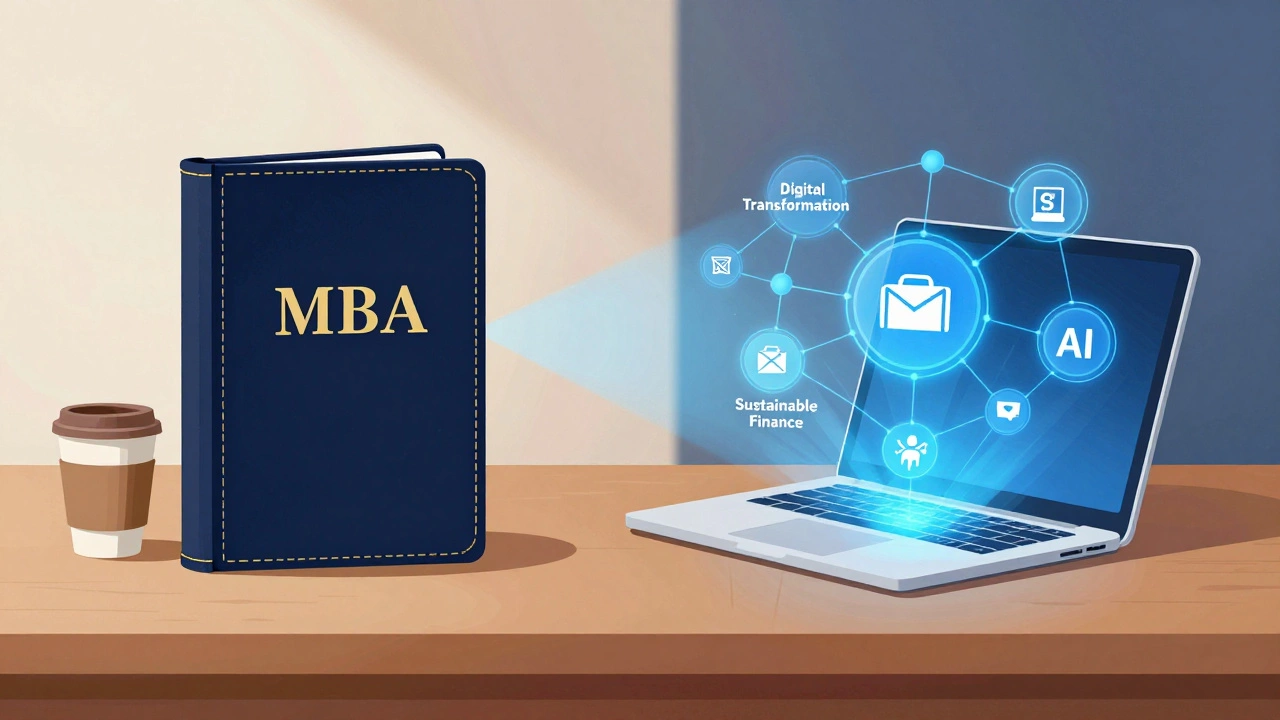
The respect now comes from specialization and outcomes. An MBA focused on Digital Transformation or Sustainable Finance carries more weight than a general management degree because it addresses current market needs. Companies are hiring for specific problems. They want leaders who understand how to integrate Artificial Intelligence into supply chains, not just people who can read a balance sheet. The degree is respected when it demonstrates that you can bridge the gap between traditional business strategy and modern technological reality.
This shift means that the "brand" of the school matters less than the relevance of the curriculum. A well-regarded program from a mid-tier university that offers strong tech-integration modules may be more respected by a hiring manager at a tech-forward firm than an outdated curriculum from a prestigious name. The market is rewarding adaptability.
Where the MBA Still Holds Power
Despite the noise about degrees becoming obsolete, there are sectors where the MBA is not just respected-it is often required. Let’s look at where the degree still opens doors that remain locked for everyone else.
- Management Consulting: Firms like McKinsey, BCG, and Bain still recruit heavily from target MBA programs. Here, the degree serves as a rigorous filter. It signals that you can handle high-pressure environments, think logically under constraints, and communicate complex ideas clearly. The network you build here is arguably more valuable than the coursework.
- Investment Banking and Private Equity: While undergraduate talent is prized, an MBA is the standard route for lateral moves into senior roles or for professionals switching from corporate banking to investment banking. The financial modeling skills and the alumni network in these industries are deeply entrenched.
- Executive Leadership Tracks: Many large corporations have formal policies that prefer or require an MBA for VP-level positions and above. In these contexts, the degree is a checkbox for leadership potential. It shows a commitment to structured learning and strategic thinking.
In these fields, the MBA is respected because it provides a common language. When you speak with other executives, you share a framework for discussing capital allocation, organizational behavior, and market positioning. This shared vocabulary reduces friction in decision-making.
The Rise of Alternatives
The reason people question the value of the MBA is that there are better, cheaper options for many goals. If your aim is to learn specific skills, an MBA is often a blunt instrument. This is where Micro-credentials and Professional Certifications have gained ground.
Consider this: Do you need a two-year degree to learn data analytics? Probably not. A certificate from a recognized platform or a specialized bootcamp can teach you Python and SQL in three months for a fraction of the cost. Similarly, project management skills are often validated through PMP Certification rather than a master’s degree. These alternatives are respected because they demonstrate immediate, applicable competency.
However, these alternatives do not replace the MBA entirely. They complement it. The MBA offers something certificates cannot: deep immersion in leadership theory, ethics, and cross-functional collaboration. You cannot simulate the experience of working in a diverse team on a capstone project for a real client through an online course. That soft-skill development is where the MBA retains its unique value proposition.
| Feature | Full-Time MBA | Professional Certification |
|---|---|---|
| Time Commitment | 1-2 Years | 3-6 Months |
| Cost Range | $50,000 - $200,000+ | $500 - $5,000 |
| Primary Benefit | Career Pivot & Network | Skill Acquisition |
| Industry Perception | Leadership Potential | Technical Competence |
| Best For | Strategic Roles, C-Suite Track | Specialist Roles, Immediate Upskilling |
The Network Effect: The Hidden Asset
If you strip away the classroom learning, what is left? The network. This is the single most cited reason why MBAs remain respected. Your classmates become your future partners, investors, and clients. The relationships built during those two years are lifelong.
In 2026, the definition of "network" has expanded. It is not just about swapping business cards at a gala. It is about access to exclusive alumni platforms, mentorship programs, and recruiting pipelines. Top schools have robust career services that connect graduates directly with hiring managers. This access is hard to quantify but easy to feel when you are job hunting. A referral from an alum carries significantly more weight than a cold application.
Moreover, the diversity of the cohort adds value. Working alongside peers from different countries, industries, and backgrounds forces you to confront your own biases and broaden your perspective. This global mindset is increasingly valued in multinational corporations. The respect for the MBA is partly a respect for the vetting process-schools admit people who are already high-performers, so the network consists of talented individuals.
ROI: Doing the Math
Respect is nice, but money talks. The return on investment (ROI) of an MBA varies wildly depending on the school and your pre-MBA salary. If you are already earning $150,000 as a software engineer, quitting to pay $150,000 in tuition for an MBA might not make financial sense unless you are aiming for a C-suite role within five years.
However, for early-career professionals earning $60,000-$80,000, the jump to a post-MBA salary of $120,000-$150,000 in consulting or finance represents a significant acceleration. Over a 30-year career, this difference compounds. The key is to choose a program that aligns with your target industry. An MBA from a school with strong ties to healthcare will yield a higher ROI for a doctor wanting to move into hospital administration than a generic business degree.
Be wary of debt. Taking on excessive loans for a low-tier MBA is a recipe for regret. The market respects the degree from top-50 programs far more than those ranked below 100. Research the employment reports of the schools you are considering. Look at the median starting salaries and placement rates. If the numbers don’t support the cost, the degree may not be respected enough in your desired field to justify the expense.

Who Should Skip the MBA?
Not everyone needs this degree. If you are an entrepreneur building a startup, time is your scarcest resource. Spending two years in school delays product-market fit. In this case, self-study, mentors, and real-world experience are more respected by investors than a diploma. VCs care about traction, not transcripts.
Similarly, if you are deeply technical and want to stay in that lane-such as becoming a Chief Technology Officer (CTO) from an engineering background-an MBA might dilute your technical credibility. Some tech leaders find that their coding skills and architectural decisions earn them more respect than business theories. In these cases, an Executive MBA (EMBA) later in your career, when you have proven operational success, might be a better fit.
Conclusion: Context is King
So, is the MBA still respected? Yes, but with caveats. It is respected as a marker of ambition, analytical ability, and social intelligence. It is respected in industries that value structured strategic thinking. However, it is no longer a standalone guarantee of success. The era of the "default" MBA is over. Today, you must treat your MBA as a deliberate investment. Choose a program that enhances your specific narrative, leverages a strong network, and fits your financial reality. When done right, it remains one of the most powerful tools for career transformation available.
Is an MBA worth it if I already have 10 years of experience?
If you have a decade of experience, a full-time MBA might be overkill. Consider an Executive MBA (EMBA) instead. EMBA programs are designed for senior professionals, allowing you to work while studying. They focus on high-level strategy and leadership rather than foundational business skills. The network in EMBA programs is also typically more senior, which can be more valuable at your career stage.
Do employers care about the ranking of the MBA program?
Yes, especially in competitive fields like consulting and investment banking. Top-tier firms often recruit exclusively from "target schools." However, in smaller companies or non-traditional industries, the specific ranking matters less than the relevance of your skills and your interview performance. A strong performance in interviews can overcome a lower-ranked school, but a top rank can open doors automatically.
Can I get an MBA online and still be respected?
Online MBAs from reputable universities are gaining respect, particularly among employers who value flexibility and self-discipline. However, they may lack the immersive networking opportunities of on-campus programs. If your goal is to pivot careers or build a new network, an on-campus or hybrid program is usually more effective. If you are enhancing existing skills within your current company, an online MBA from a respected institution is a solid choice.
What skills do I gain from an MBA that I can't get elsewhere?
The core differentiator is the integration of diverse business functions. You learn how marketing, finance, operations, and HR intersect. Additionally, you develop soft skills like negotiation, public speaking, and team leadership through group projects and case competitions. The exposure to ethical dilemmas and strategic ambiguity in a safe academic environment is also unique to the MBA experience.
How has AI impacted the value of an MBA?
AI has automated many analytical tasks traditionally taught in MBAs, such as basic financial modeling and data crunching. This has forced MBA programs to evolve. The value now lies in human-centric skills: leadership, emotional intelligence, creative problem-solving, and strategic vision. An MBA that teaches you how to leverage AI tools for decision-making is more valuable than one that focuses solely on manual analysis.